Polish rail: 40.3 million passengers in July and the lowest accident rate on record
For the first time since UTK began its monthly counts, more than 40 million people travelled by rail in Poland in July. But 92 accidents at level crossings pushed the President of UTK to call an emergency meeting of his safety team.
 Daniel FisherSport, cars and travel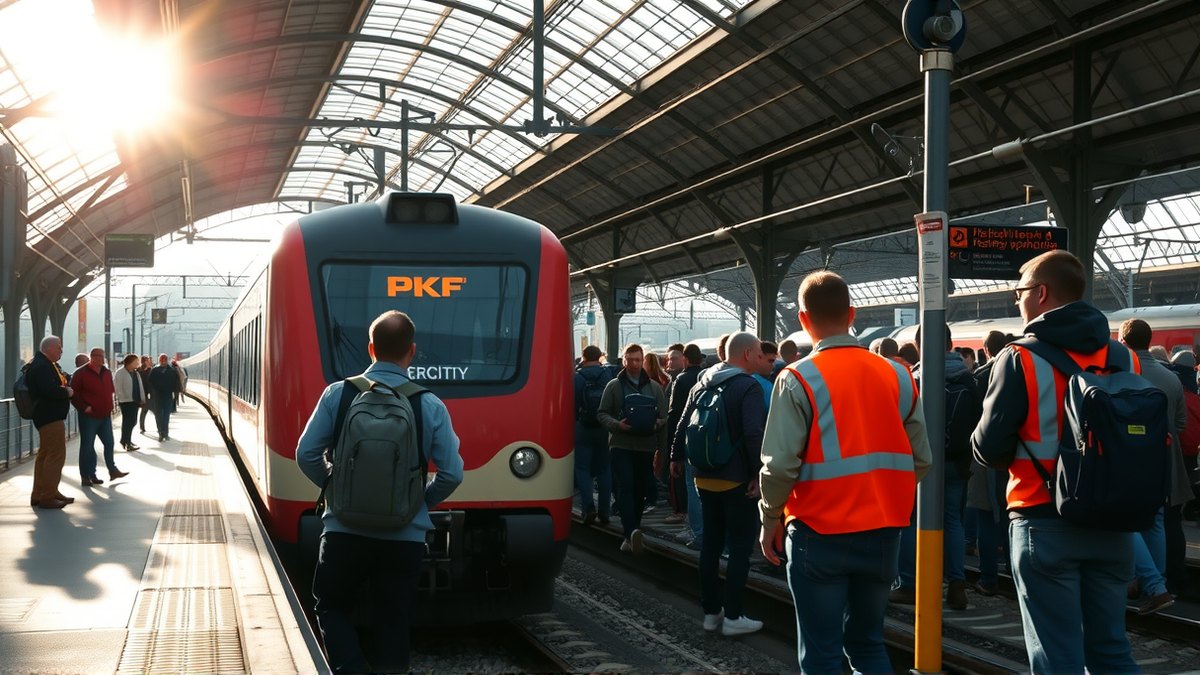
Polish rail had a record July. Passenger carriers served 40.3 million people. That is the first time since the Railway Transport Office (UTK) started its monthly statistics that the July figure has passed 40 million, and the third such month in 2026. Year on year, 3.6 million more people travelled by rail than in July 2025, a rise of 9.9 percent.
Passenger transport performance reached 3.3 billion passenger-kilometres, up 8.7 percent. Operational performance hit 21.3 million train-kilometres, 7.2 percent more than a year earlier. The average distance covered by a statistical passenger fell by one kilometre, to 82.2 km. Part of the growth, then, comes from shorter, everyday journeys. July carried 1.2 million more passengers than June, a rise of 3 percent.
From January to July 2026, 269.9 million passengers used the railway, 22 million more than in the same period a year earlier. In freight, the mass of goods carried in July came to 19.5 million tonnes, the highest figure of the whole of 2026.
Safety: 622 accidents, but the lowest rate on record
Separately, UTK published its Report on the state of safety in rail traffic for 2025. The accident rate came in at 1.59, the lowest since the President of UTK began calculating it. In 2025 there were 622 accidents on lines and sidings, one fewer than in 2024, and one event was classified as a serious accident. Railway lines saw 8 fewer accidents, sidings 7 more.
The structure of those events matters most. Nearly 76 percent of accidents on the rail network, or 367 events, were linked to the so-called third party, meaning causes and people from outside the railway system. These are mainly people struck while crossing in unauthorised places, plus accidents at level crossings. In such events 175 people died, 11 more than in 2024, and 43 were seriously injured, 7 fewer.
"As many as 98.9 percent of fatalities and 97.7 percent of serious injuries on railway lines are people hurt in events whose causes lay outside the railway system," says the President of UTK, Ignacy Góra. In his view, educational measures are needed alongside technical solutions.
Level crossings under scrutiny
Level crossings remain the weakest point. On 17 September 2026 UTK reported that 92 accidents had already happened at them this year. Most of the events occur at category D crossings, the most numerous group in Poland, which should be fitted with intelligent monitoring systems.
The President of UTK called an emergency meeting of the Team for monitoring the safety level of the rail sector for 16 September 2026. Those taking part included deputy infrastructure minister Piotr Malepszak, deputy justice minister Arkadiusz Myrcha, and representatives of the Interior Ministry, the Education Ministry, GITD, the National Public Prosecutor's Office, PKBWK, SOK, the National Police Headquarters, PKP PLK, rail carriers and universities. The institutions have one month to present a plan of action to improve safety where road and rail meet.
Sources
3- 01UTK — Wyniki przewozowe w lipcu 2026 rokuPL
- 02UTK — Sprawozdanie ze stanu bezpieczeństwa w ruchu kolejowym 2025PL
- 03UTK — Klucz do bezpieczeństwa na przejazdach kolejowo-drogowychPL
All figures and quotations in this text come from the sources listed below.
Content prepared by the editorial team with AI assistance.
Daniel Fisher
Comments
0- No comments yet — be the first.