UK MoD awards Astroscale UK £15m for Project LEDA spacecraft
The UK Ministry of Defence announced on 28 October a £15 million ($20 million) contract with Astroscale UK to develop and operate spacecraft for Project LEDA, intended to improve understanding of orbital warfare and counter close-approach threats.
 Sofia MarchettiScience and health
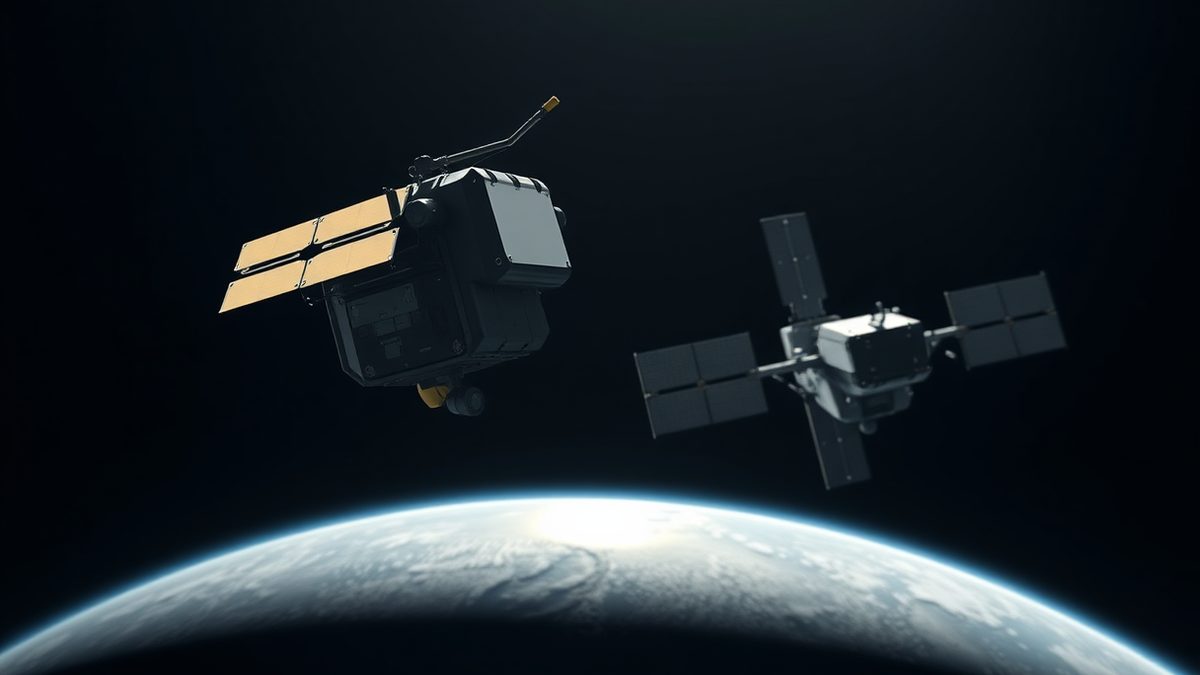
The contract
The contract was signed on 29 September and announced on 28 October, according to Aerospace Global News. It makes Astroscale UK the prime contractor for Project LEDA, with BAE Systems and Open Cosmos supporting the programme.
The Ministry of Defence said the contract covers the manufacture, launch and operation of spacecraft intended to improve the UK's understanding of orbital warfare and how manoeuvrable satellites could be used to counter threatening activity near military and other important space assets. Astroscale will lead the work from its UK operations, drawing on previous missions involving inspection, close approaches and orbital manoeuvring.
The announcement did not describe LEDA as an order for a fleet of armed bodyguard satellites. It did not identify an operational deployment date.
Why close approaches matter
RPO, or rendezvous and proximity operations, means a spacecraft manoeuvring close to another object in orbit. The techniques are used for satellite inspection, servicing and debris removal, but can also be used to approach another country's spacecraft without its cooperation.
A bodyguard satellite might patrol near military communications or intelligence spacecraft, photograph an approaching object and move into position if its behaviour appears threatening. Some proposed systems would go further, using robotic arms or other mechanisms to capture and move an intruding satellite.
In mid-October, Russia's Kosmos-2612 approached ICEYE-X36, a radar imaging satellite operated by Finland-headquartered ICEYE. ICEYE's satellite network provides imagery that can support Ukraine's defence. The approach raised concerns about possible surveillance or interference, although there is no publicly established evidence that Russia attempted to damage the spacecraft.
A reconstruction by US space-tracking firm COMSPOC, reported by Il Sole 24 Ore, found that between 16 and 18 October the two vehicles spent about 24 hours within two kilometres of each other and about 12 hours within one kilometre. It put the closest pass on 17 October at about 60 metres, with an uncertainty of up to about 950 metres at that point of the trajectory. COMSPOC calculated relative speeds of 15 to 90 centimetres per second at closest approach. ICEYE-X36 did not manoeuvre, and the Russian satellite moved away on 18 October.
The reconstruction describes an orbit raise, a catch-up phase and engine burns to reach ICEYE-X36's plane and altitude, and concludes that Kosmos-2612 did not arrive by chance.
Astroscale's track record and the UK budget
Astroscale's ELSA-d mission demonstrated rendezvous and magnetic capture of a client spacecraft. Its ADRAS-J mission approached and inspected an abandoned Japanese rocket body in 2024, reaching a distance of less than 15 metres. Astroscale UK developed the ground segment for ADRAS-J and led flight dynamics operations, including manoeuvre planning and collision risk monitoring.
The Secure World Foundation's 2026 Global Counterspace Capabilities Report identifies growing interest in manoeuvrable satellites and orbital bodyguards as governments seek ways to respond to such activity. Russian Luch satellites have also conducted proximity operations near Western communications satellites in geostationary orbit, where many valuable military and commercial spacecraft operate.
The UK's new Space Strategy names defence and national security as priorities and calls for greater protection of the country's space infrastructure. It notes that disruption to communications, navigation or intelligence satellites could affect armed forces as well as businesses and public services. The government has allocated £3.2 billion for space through 2030 under its Defence Investment Plan. The £15 million LEDA award compares with that £3.2 billion allocation.
What happens next
Tony Williams, head of space capability at UK Space Command, said LEDA would form part of the permanent pathway for the UK's understanding of orbital warfare and how such spacecraft operate and might be employed to counter RPO threats.
"Control of space is not about seeking conflict in space, it is about demonstrating that we can protect the capabilities upon which our economy, our society, and our armed forces depend," Williams said.
Astroscale's head of defence, Alex Godfrey, told Space.com that the company believed it could develop a bodyguard spacecraft ready for launch within three years.
Sources
20- 01"Bodyguard" satellites move closer to reality as UK awards Astroscale £15m contractEN
- 02UK awards Astroscale £15m contract to develop orbital defence capabilitiesEN
- 03Il satellite russo che fa il gatto con il topoIT
- 04Drone warfare in space: Swarms of autonomous, laser-shooting cubesats could defend Western satellites in orbitEN
- 05Insurer Guardian hands 1 million dental calls a year to Sierra’s AI agentsEN
- 06Electric Buses Need a Plan for the Next Operating ContractEN
- 07Elon Musk Threw Away $474 Million (Or More) … But May Benefit From FailingEN
- 08AI PACs spent millions trying to shape Congress — here’s how they faredEN
- 09 Certified Android TV manufacturer put unauthorized backdoor in 1.3 million set-top boxes, Google reveals EN
- 10Nearly 1.5 million exposed secrets targeted in new revocation programEN
- 11Quint Computing raises €9.1 million for development of fault tolerant quantum computing architectureEN
- 12How Far Can You Steer? Behavior-Capability Frontiers in Contrastive Activation AdditionEN
- 13Launch Preview: Falcon 9 to launch USSF missions, China to launch internet satellitesEN
- 14Astranis Upgrades Falcon 9 Launch Contract to Dedicated Mission for Entire Block 4 Production Run of SatellitesEN
- 15Google Disrupts 1.3 Million-Device Android Botnet, Says TV Box Maker Sold Criminal AccessEN
- 16Hackers Steal About $2.7 Million From Polymarket Traders via Hijacked DebugBear ScriptEN
- 17Cloudflare Reports 18.2 Million Network-Layer DDoS Attacks in Q3, Up 38%EN
- 18Ukrainian startup, GomSpace test satellite for future communications networkEN
- 19How AI Is Changing the Pace of Discovery for Millions Living With DementiaEN
- 20Satellite Mission Management at the EdgeEN
All figures and quotations in this text come from the sources listed below.
Content prepared by the editorial team with AI assistance.
Sofia Marchetti
Comments
0- No comments yet — be the first.