Volvo's Electric Trucks Win 2027 Title as Grid Spending Lags Behind
Volvo Trucks' new heavy-duty electric range was named International Truck of the Year 2027 at IAA Transportation on 27 September. The same week, a $1.9 billion US grid grant programme and a Chinese storage market reform showed how unevenly the infrastructure behind electrification is being built.
 Dr. Amara PatelEconomy, business and world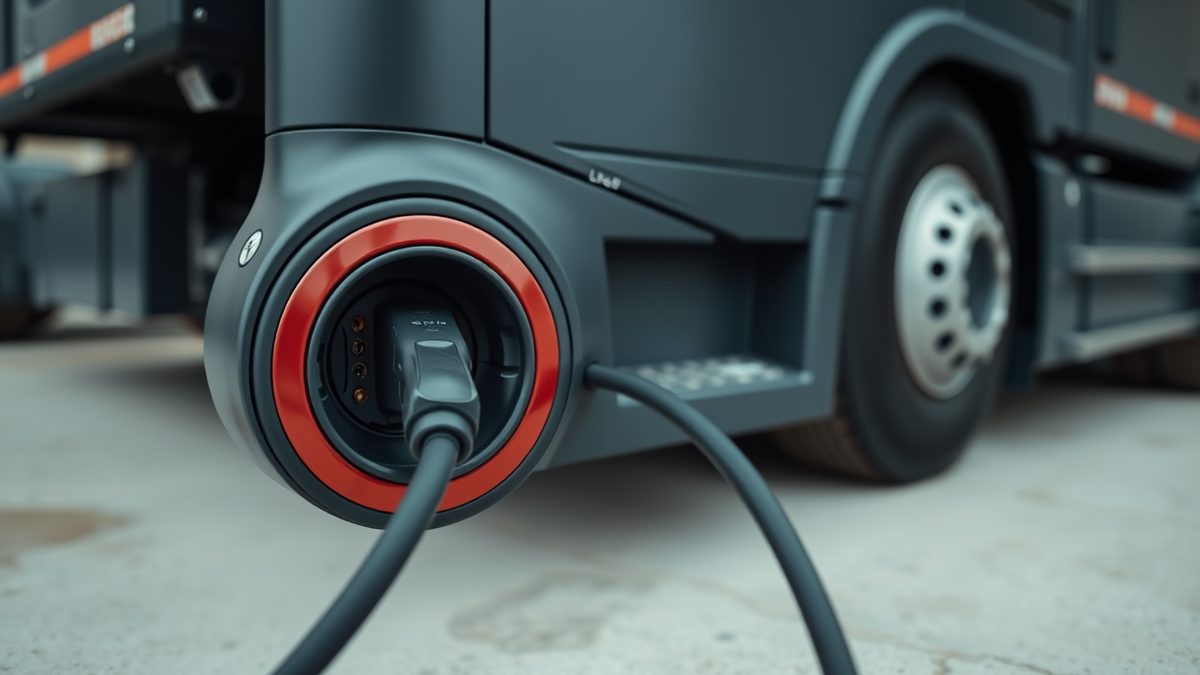
Volvo Trucks' new generation of heavy-duty electric trucks was named International Truck of the Year 2027 at IAA Transportation in Hanover, Germany, on 27 September, according to CleanTechnica. It is the Swedish manufacturer's eighth win of the award and the second time the FH Electric has taken the title, after it became the first battery-electric truck to win in 2024.
The jury cited longer driving distances, energy efficiency, payload capability and flexibility across transport applications. The range covers the FH Electric, FM Electric, FMX Electric and the new FH Aero Electric. Volvo says the flagship FH Aero Electric can travel up to 700 kilometres on a single charge, with megawatt charging support, while the next-generation FH, FM and FMX models reach up to 470 kilometres.
Series production of the new heavy-duty electric trucks began on 14 September at Volvo's Tuve plant in Gothenburg, with additional production planned in Ghent, Belgium. Volvo also introduced an electric truck combination rated for gross combination weights of up to 80 tonnes, with a claimed range of up to 450 kilometres and megawatt charging, scheduled to enter the market in early 2027.
Volvo says about 7,000 of its electric trucks have accumulated roughly 500 million kilometres since the company introduced its first electric models in 2019, with nearly 2,000 customers in more than 50 countries operating them. The company is also showing a hydrogen-powered internal-combustion engine truck at IAA as part of a multi-powertrain approach to heavy transport.
That hardware milestone sits next to a much slower story about the wires and markets that electric fleets depend on. On 24 September, the US Department of Energy awarded $1.9 billion through its SPARK grant programme to 31 projects across 26 states, Canary Media reported. Participating utilities pledged a collective $3.35 billion in matching funds, bringing total investment to $5.25 billion.
The money goes to advanced conductors, dynamic line rating systems and grid controls, technologies that increase capacity on existing corridors without building new towers. Energy Secretary Chris Wright said in a Thursday statement that the grants will "get more out of the infrastructure we already have, move more electricity across the grid, and help deliver affordable, reliable, and secure power that will fuel American prosperity for decades to come."
Recipients include American Electric Power, CenterPoint Energy, Duke Energy, Eversource Energy, Rocky Mountain Power and PPL Electric Utilities, plus four public power utilities and rural electric cooperatives in Arizona, New Mexico and North Carolina. Two of the largest awards, $250 million each, go to a $1.2 billion project led by the Colorado Energy Office and an $832 million project by the Oklahoma Office of Management and Enterprise Services, both meant to expand power sharing between the Eastern and Western US grids.
SPARK reuses money obligated under the 2021 bipartisan infrastructure law, and Canary Media calls it a rare example of alignment between the Trump and Biden administrations on energy policy even as Trump appointees have blocked billions in other Biden-era grants. Julia Selker, executive director of the Working for Advanced Transmission Technologies Coalition, said the experience developed through the grants "will be phenomenal", adding that the federal funding means "the taxpayer split the cost" for utility ratepayers.
Storage and charging markets move at different speeds
In China, regulators in Zhejiang province have opened the provincial electricity spot market to independent grid-side batteries, with price-and-quantity bidding planned from 1 January 2027. According to a regulatory statement issued on 23 September and reported by pv magazine, the notice was jointly issued by the Zhejiang office of the National Energy Administration, the provincial development and reform commission and the provincial energy bureau.
A project list attached to the notice covers 40 projects totalling 2.54 GW/5.1 GWh. Of those, 28 projects totalling 2.13 GW/4.27 GWh are in commercial operation and centrally dispatched, making them eligible for both the energy and frequency-regulation markets. A further six operating projects, totalling 0.11 GW/0.22 GWh, can enter only the energy market. The move follows China's 2025 decision to scrap its energy storage mandate for renewable energy plants and the capacity price floor for grid-scale storage set in February.
Fleet operators outside China are already running electric trucks at commercial scale. Electrek reported on 26 September that JUNA, a joint venture between German logistics firm sennder and Scania, deployed its 110th battery-electric semi truck. Since deploying its first electric trucks two years ago, JUNA's Scania fleet has travelled more than 3.9 million emissions-free kilometres across Germany, Italy, Poland and the Netherlands, and the company plans to add as many as 40 more trucks before the end of the year.
Gustaf Sundell, executive vice president and head of ventures and new business at Scania Group, said reaching 100 trucks across four markets shows "that this proof point is real". The Scania R45 packs a 450 kW electric powertrain, hauls up to 40 tonnes for up to 350 kilometres on a 624 kWh battery and can recover 80 percent of its range in about an hour on 375 kW DC fast charging.
Charging capacity remains the bottleneck in the US. Ars Technica reported on 26 September that Tesla launched high-volume production of the Semi at its Sparks, Nevada factory on Thursday, with a long-range version estimated at 500 miles per charge and a standard version at 325 miles. Tesla's website shows two public megawatt chargers operating in the LA area, though Dan Priestley, who leads the Semi programme, says the company plans to open 30 by the end of the year. Competitor EVs advertise ranges of 155 to 430 miles.
An alliance of shippers including Microsoft and PepsiCo placed an order for 2,500 Tesla Semis, to be delivered starting this year and through the next 18 months, according to Ars Technica. If those trucks reach customers, they would nearly double the number of heavy-duty electric trucks on US roads today.
Smaller grid projects are also moving. Canary Media reported on 23 September that First Student and Con Edison completed the initial phase of a $9 million pilot in East New York, Brooklyn, with 10 electric school buses and an aboveground charging system built to avoid a jet-fuel line running beneath the depot. First Student estimates the non-trenching design saved nearly 20 percent in project costs and accelerated the timeline by a month. Forty more buses will be delivered by June, and Con Edison forecasts that electric buses, trucks and other commercial vehicles will add over 100 megawatts of electricity demand by 2030.
Across the United States, more than 8,500 electric school buses were operating as of June 2026, up 66 percent year on year, according to the World Resources Institute. New York lawmakers recently pushed back the state's all-electric school bus mandate by five years, to 2040.
On the financing side, Nordic energy company Fortum has joined Norrsken Evolve as a limited partner, investing through its innovation and venturing arm after the pre-seed fund's oversubscribed €62 million final close this summer, Tech.eu reported on 25 September. Norrsken Evolve has backed over 80 companies to date, 75 percent of which have gone on to raise follow-on investment. The fund backs companies working on electrification, flexibility and industrial decarbonisation.
Between Volvo's 700-kilometre truck, Zhejiang's storage market rules and the DOE's transmission grants, the direction of travel is consistent. The pace is not. Truck makers are shipping vehicles into a charging and grid market that is still being designed, funded and, in some cases, litigated.
Sources
7- 01Volvo's Electric Trucks Win International Truck of the Year 2027 at IAAEN
- 02Advanced grid tech gets a $1.9B DOE boostEN
- 03Chinese province moves grid-side batteries into spot marketEN
- 04JUNA puts more than 100 Scania electric semi trucks to workEN
- 05Tesla's big electric truck faces an even bigger infrastructure challengeEN
- 06A new fleet of electric school buses hits New York City streetsEN
- 07Fortum backs Norrsken Evolve's €62M fund to accelerate Europe's electrificationEN
All figures and quotations in this text come from the sources listed below.
Content prepared by the editorial team with AI assistance.
Dr. Amara Patel
Comments
0- No comments yet — be the first.