Wearables in sleep research: what the data can and cannot show
A University of Texas at Austin study published in Nature Scientific Reports used wrist-worn trackers to follow 82 young adults for weeks and months. Physical activity lengthened REM latency. Consumer wearables are moving from fitness gimmicks to research instruments.
 Sofia MarchettiScience and health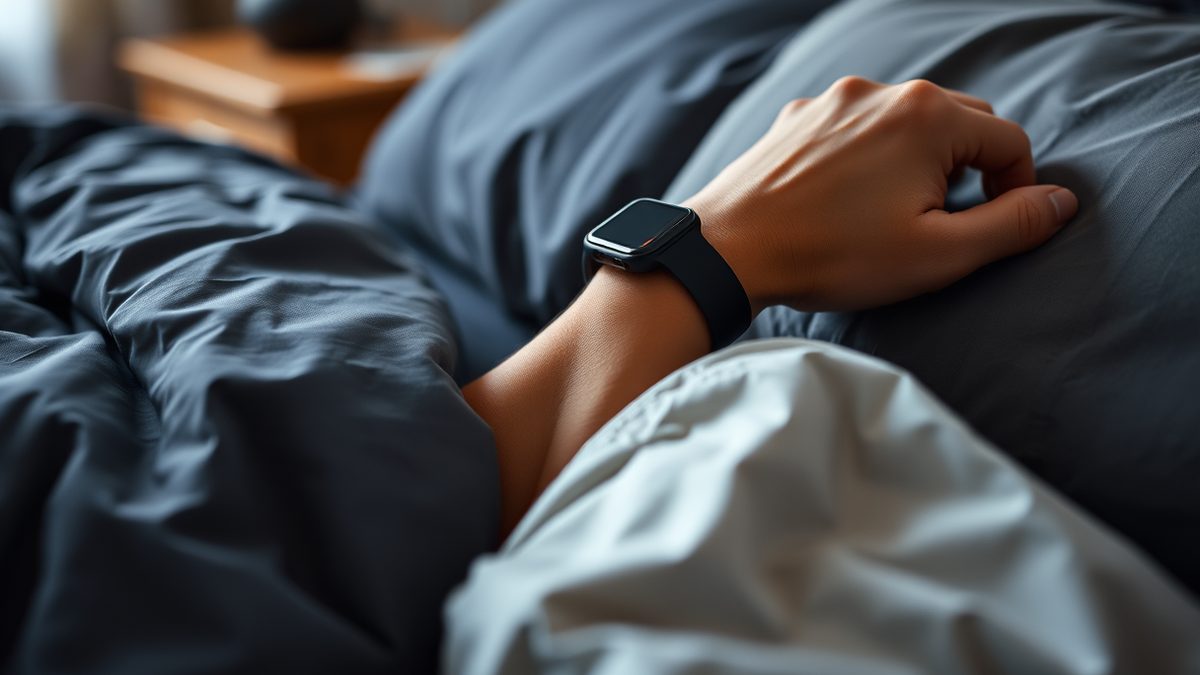
An interdisciplinary team at The University of Texas at Austin tracked 82 young adults with a wrist-worn activity tracker that recorded movement and heart rate. A separate smartphone app collected self-reported well-being data. The team says the work, published in Nature Scientific Reports, is the most reliable validation to date of the link between physical activity, sleep quality and psychological health.
The headline finding is narrow. Physical activity lengthened REM latency, the time it takes to enter REM sleep. The researchers suggest exercise may help consolidate deeper sleep stages before the brain shifts into REM, the stage tied to vivid dreams and near-waking brain activity.
From the lab to the bedroom
Sleep science has a methodology problem. Most studies run in labs, over a single night, with electrodes and unfamiliar beds. Benjamin Baird, a research assistant professor of psychology and one of the authors, put it plainly in the university's release: "You can learn a lot from lab studies, but obviously there are limitations to studying the sleep patterns of individual participants in just one night." Baird added that the clinical setting can be stressful and that a single night cannot show change over time.
The Texas team tried to work around that by measuring people at home, at work and during daily activities over several months. The study replicated several lab findings. Low-intensity and moderate-to-vigorous activity were both linked to deeper, more restorative sleep, and better sleep was in turn associated with more energy and less stress the following morning. The difference was the continuous monitoring, which produced a picture of daily behaviour over weeks and months rather than one night.
"We've shown using a standard Fitbit that anyone could wear, not even an expensive scientific device, that it is actually sensitive to these sorts of sleep architecture measures, and in a way that's showing predictive results," said David M. Schnyer, co-author and chair of the Department of Psychology.
Schnyer's claim is the one worth testing against the wider field. If a consumer device can pick up sleep architecture reliably, research questions that were previously confined to labs become cheap and large. The Texas study is small, at 82 participants, and it relies on a consumer tracker, not polysomnography. But it is not the only group pushing in this direction.
A world wired for sleep data
ABC News reported on 24 September 2024 that sleep-tracking has boomed worldwide, giving researchers access to millions of hours of data. The Australian broadcaster described how data scientists in Sweden detected a disturbance in sleep after a powerful earthquake hit New South Wales, with an above-average number of people in the surrounding area briefly waking. The data came from Sleep Cycle, a Swedish-made sleep-tracking app.
Michael Gradisar, Sleep Cycle's head of science, told ABC News that sleep is one of the first things to go wrong in a person's health. "Sleep is the canary in the mine," he said. Gradisar also described how the company's data scientists spotted an increase in night-time coughing in New York roughly one week before confirmed Omicron cases rose. He called it a kind of early warning system.
The regulatory picture has shifted too. ABC News reported that in early 2024 Samsung's smart watch sleep apnoea detection system received approval from the US health regulator after an eight-month review, the first consumer smart watch to clear that hurdle. Apple's smart watch received the same approval later that month, according to the same report. Danny Eckert, director of the Adelaide Institute for Sleep Health at Flinders University, told ABC News that a 2022 study he co-authored found up to half of single-night diagnostic studies for sleep apnoea, the current gold standard, misclassify severity.
That is the strongest argument for wearables in this space. They do not beat a sleep lab on any single night, but they can measure every night for weeks, months and years. Eckert's point about noisy single-night tests cuts against the lab's authority rather than the wristband's convenience.
Where the evidence is thinner
The Texas study measured REM latency, deep sleep, energy and stress. It did not diagnose anything. The distinction matters because consumer sleep tech is marketed far more aggressively than it is validated. Affectable Labs, a company selling a headband called UltraSleep, claims on its site that its "patent-pending" micro-auditory neurostimulation builds on more than a decade of research and over 50 peer-reviewed studies in slow-wave enhancement. The page lists benefits including clearer thinking, stronger memory, immune regulation, heart and metabolic health and emotional resilience. Those are marketing claims on a product page, not findings from the Texas study or from ABC News's reporting.
There is a gap between what researchers can extract from wearable signals and what device makers say those signals mean. The Texas team is explicit that it used a standard Fitbit and that the results are predictive, not diagnostic. Schnyer's quote is about research capability, not clinical approval.
Health tech more broadly is moving in the same direction, with more ambitious claims attached. Rest of World published an interview on 24 September 2026 with Ruby Wang, a physician and consultant, about her upcoming book China Cure: The Rise of a Biotech, AI Medicine, and Global Health Superpower. Wang described China's digital health infrastructure as technologically enabled to the point where society accepts it as normal. In the UK and US, she said, tech is always an add-on to a health system that is already built. She also said China's digital health is not directly exportable, adding that the West would never accept an AI doctor avatar. Her comments are about health tech generally, not sleep wearables, but the underlying tension is the same one the Texas study sits inside: what can be measured, what can be inferred, and what can be sold.
What to watch
The practical question for anyone reading sleep-wearable research is what the device actually recorded. The Texas study used movement and heart rate to infer sleep stages. That is a model, not a direct read of brain activity, even if the model performs well enough to show predictive results. ABC News noted that David Walsh built the first Apple Watch sleep-tracking app in 2016 by studying movement and heart rate data, and that the app, AutoSleep, now has more than 5 million users according to Walsh. The method has not changed fundamentally since.
What has changed is scale. Millions of users generate data every night, and researchers can now look at population-level shifts in sleep around events like earthquakes, holidays or disease waves. The Texas study points in the same direction with a smaller, more controlled design: measure people where they live, for long enough that the findings are not an artefact of one strange night in a lab.
None of this settles whether exercise reliably lengthens REM latency in the general population, or whether the effect is large enough to matter clinically. The Texas sample is 82 young adults. The finding is a correlation from a wearable-derived model. The interesting part is the method: a standard consumer device, worn at home, over months. That is a cheaper and more realistic way to study sleep than a lab, and it is why the field is paying attention.
Sources
4- 01Move More, Sleep Better, UT Study FindsEN
- 02Sleep-tracking devices are wiring the world for the study of sleep. What will we find?EN
- 03China is excelling in health tech. That's good news for the worldEN
- 04Affectable Labs UltraSleep product pageEN
All figures and quotations in this text come from the sources listed below.
Content prepared by the editorial team with AI assistance.
Sofia Marchetti
Comments
0- No comments yet — be the first.