Boston Dynamics' new Atlas hand has four fingers and 13 degrees of freedom
Boston Dynamics unveiled a new hand for its Atlas humanoid on 1 October, dropping the pinky finger to cut cost and complexity as the company prepares to put the robot to work inside Hyundai's car plants.
 Rachel NwosuAI, models and technology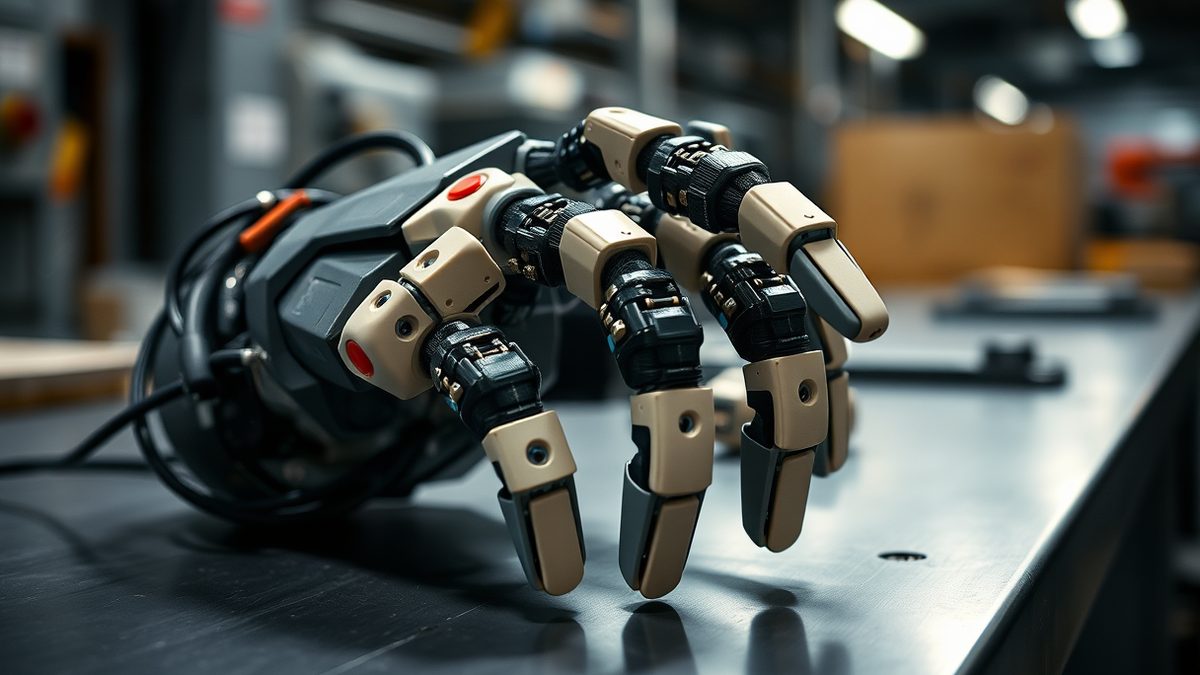
Boston Dynamics unveiled a new hand for its Atlas humanoid on 1 October. The hand has four fingers and 13 degrees of freedom, is directly actuated, and is built for mass manufacturing, the company said. Its previous hand had seven degrees of freedom and was designed to grasp a wider variety of objects.
The design decision was deliberate, and it went against the industry's instinct to copy human anatomy as closely as possible.
"There's no pinky because the team determined that the additional dexterity and tasks you'd be able to accomplish is not worth the extra complexity of three additional degrees of freedom, the size, the power consumption, all of the things that come with adding additional actuators," Dylan Thrush, a mechanical engineer on the Atlas team, said in The Robot Report's write-up of the launch.
The company also said it kept transparent direct actuation at every joint using a single actuator type, with the actuators fully encapsulated so no fragile cables cross the joints. The hand is sized like a large human hand, which drives the size of the actuators, and Boston Dynamics says it maintained similar strength to the previous version.
From grasping to doing
The shift matters because a robot that can pick something up is not the same as a robot that can use it. Boston Dynamics said the four-fingered hand is built for high fidelity simulation to enable sim-to-real reinforcement learning, and it lists sliding a thumb along the other fingers, dexterous pinch grasps, and triggered tool grasps with drills, power torque drivers, grinders, nail guns and welding torches as target capabilities.
Alberto Rodriguez, the company's director of robot behavior for Atlas, framed the trade-off plainly. "We considered many, many designs, and there were many questions like: Do we want the hand to have one thumb or two thumbs? Do we really want the hand to have a pinky or not? And most of these don't have straight answers," he said. "There's always some amount of intuition and experimentation. It boils down to a trade of different competing objectives."
Before the design was frozen, Zachary Jackowski, Boston Dynamics' chief product and technology officer, asked the team to tape their pinky and ring finger together for a day and report back on what they could not do. By the end of the experiment, the team had agreed the robot hand did not need a pinky.
The launch came a week after Boston Dynamics opened its Robotics Metaplant Application Center at Hyundai Motor Group Metaplant America. The company describes the Georgia facility as a training center for integrating Atlas humanoids into parent Hyundai's automotive manufacturing operations.
Production is the hard part
Hands are where humanoid programs keep running into trouble. Tesla's Optimus effort shows what happens when a design is not ready for the line: The Information reported that workers must manually assemble Optimus hands and forearms containing more than 100 small components such as screws, that newly produced robots need immediate fixes, and that touch sensors proved unreliable enough that Tesla developed a replaceable glove-like sensor layer.
Ars Technica's account of that reporting also notes Tesla's Fremont factory stopped making the Model S and Model X in May 2026, with line workers and engineers moved onto Optimus. The company has reportedly scaled to hundreds of robots per week while targeting more than 1,000 per week by the end of 2026. The report adds that Tesla workers have pushed back against training their robotic replacements.
Against that backdrop, the industrial numbers keep pointing the other way. The International Federation of Robotics said in its World Robotics report, published on 24 September, that the global operational stock of industrial robots rose 9% in 2025 to a record 5.08 million units, with annual installations up 11% to 603,000. China installed 354,000 robots, up 20%, and now accounts for 59% of global deployments, according to the IFR.
Humanoids remain a rounding error next to that. Only about 7,000 were sold worldwide in 2025 for industrial and professional use, the IFR said in a separate release, the first time it tracked the category. Euronews reported on 29 September that many of those units were bought to generate training data for AI models rather than to do work, and that car manufacturers piloting them typically run fewer than ten machines.
"Industrial automation is progressing at high speed," said Jane Heffner, the IFR's president. "The new mark of five million robots operational in factories worldwide is more than double the number seven years ago. The strongest growth is taking place in Asia, followed by the Americas. Europe is moving ahead more slowly."
Shipment data for 2026 is running hot by comparison. TechNode reported on 29 September that China shipped more than 19,000 humanoid robots in the first half of 2026, accounting for 77.9% of global shipments, citing figures attributed to IDC. Global shipments reached nearly 25,000 units, up 432.1% year on year, and IDC raised its 2030 forecast to more than 750,000 units.
China is building the capacity first
The manufacturing base for that volume is being assembled in China. UBTECH began operations at a humanoid robot factory in Liuzhou, Guangxi, on 12 September, according to a report by Let's Data Science citing Interesting Engineering. The 14,000-square-metre plant is designed for annual capacity above 10,000 units, with a line rate of one completed robot every 10 minutes, producing the Walker S and Cruzr series.
The same account says each finished robot requires more than 2,000 screws across different specifications, that Cruzr robots handle depalletizing, palletizing and material loading, and that collaborative arms and rotating workstations tighten screws during assembly. NDTV reported that each unit undergoes more than four hours of testing and a 360-degree inspection.
Adalytica, reporting on 28 September, put the commercial picture next to the capacity number: UBTECH delivered 921 full-size humanoids in the first half of 2026, generating 1.27 billion yuan in revenue but still posting a 339 million yuan loss. The outlet noted that global humanoid sales were only about 7,000 units in 2025, meaning UBTECH alone is preparing for annual output that exceeds the entire market's recent global sales.
The gap between factory capacity and order books is the sector's central tension, and it is not only a Chinese problem. Hyundai's leadership has signalled that Boston Dynamics is unlikely to pursue a stock listing next year, because Atlas has yet to be deployed at scale and the company remains unprofitable, according to Euronews. In China, regulators have reportedly used informal guidance to hold back a rush of humanoid IPOs.
Sensing, memory and the quiet bottlenecks
Even a well-designed hand needs a supply chain behind it. Vishay Precision Group said it will present custom force and torque sensing at RoboBusiness 2026, arguing that stock sensors are often too large for small robot limbs and force engineers to redesign parts just to fit them. "At VPG, we focus on providing precision sensing solutions exactly where they are needed most: at the key points of performance, safety, and control in advanced intelligent systems," said Ron Zukerman, the company's innovation director.
ForceN founder Robert Brooks will give a talk titled "A Crash Course in Force & Torque Sensing for Humanoids" at the same event, based on three years of work with humanoid companies and on sensor development from surgical and logistics robotics.
Memory is another under-discussed constraint. A SemiEngineering article published on 1 October notes that logging motor torque, velocity and limb position data at sampling rates above 10 kHz can quickly exceed the endurance limits of conventional non-volatile memories, which pushes humanoid designers toward distributed memory architectures rather than one central store. The same piece cites Goldman Sachs analyst estimates that annual humanoid robot shipments could reach more than 6 million units by 2035, up from fewer than 15,000 units in 2025.
Security researchers argue the safety case deserves the same scrutiny. VicOne LAB R7 described tests in which text on a poster was treated as an instruction by a robot dog, and in which crafted inaudible audio changed the simulated behaviour of a hospital-service robot running on an NVIDIA Jetson AGX Orin. At a robotics bug bounty event, its researchers injected a ROS 2/DDS message into a robot that organisers expected to remain still. The robot moved.
The common thread is that a robot can follow its safety rules and still act on manipulated information. That is a testing and evidence problem as much as a hardware one, and it is the kind of issue that tends to surface after deployment, not before.
Sources
11- 01Boston Dynamics drops pinkie on new humanoid handEN
- 02Tesla workers balk at training Optimus humanoid robots as replacementsEN
- 03Five Million Robots now Operate in Factories GloballyEN
- 04Five million robots now work in factories as humanoid hype faces reality checkEN
- 05China accounts for 77.9% of global humanoid robot shipments in H1, IDC saysEN
- 06UBTECH Opens High-Volume Humanoid Robot FactoryEN
- 07UBTECH Opens Humanoid Robot Factory in LiuzhouEN
- 08Vishay Precision Group (VPG) to Showcase Custom Sensing Capabilities for Humanoid Robotics at RoboBusiness 2026EN
- 09Memory At The Edge: Non-Volatile Memory Challenges And Requirements For Humanoid RobotsEN
- 10Your Robot's Safety Functions Already Work. What If the Input Lies?EN
- 11ForceN to give a crash course on force and torque sensing for humanoids at RoboBusinessEN
All figures and quotations in this text come from the sources listed below.
Content prepared by the editorial team with AI assistance.
Rachel Nwosu
Comments
0- No comments yet — be the first.