Chemours starts selling two-phase cooling fluids as AI racks head for 4,000 watts
Chemours launched Faizeon, two-phase liquid cooling fluids for AI, high-performance computing and high-density data centres, on 4 November. It says a Faizeon 200 direct-to-chip system held a GPU up to 19 degrees Celsius lower than a single-phase water-based fluid in third-party testing.
 Rachel NwosuAI, models and technology
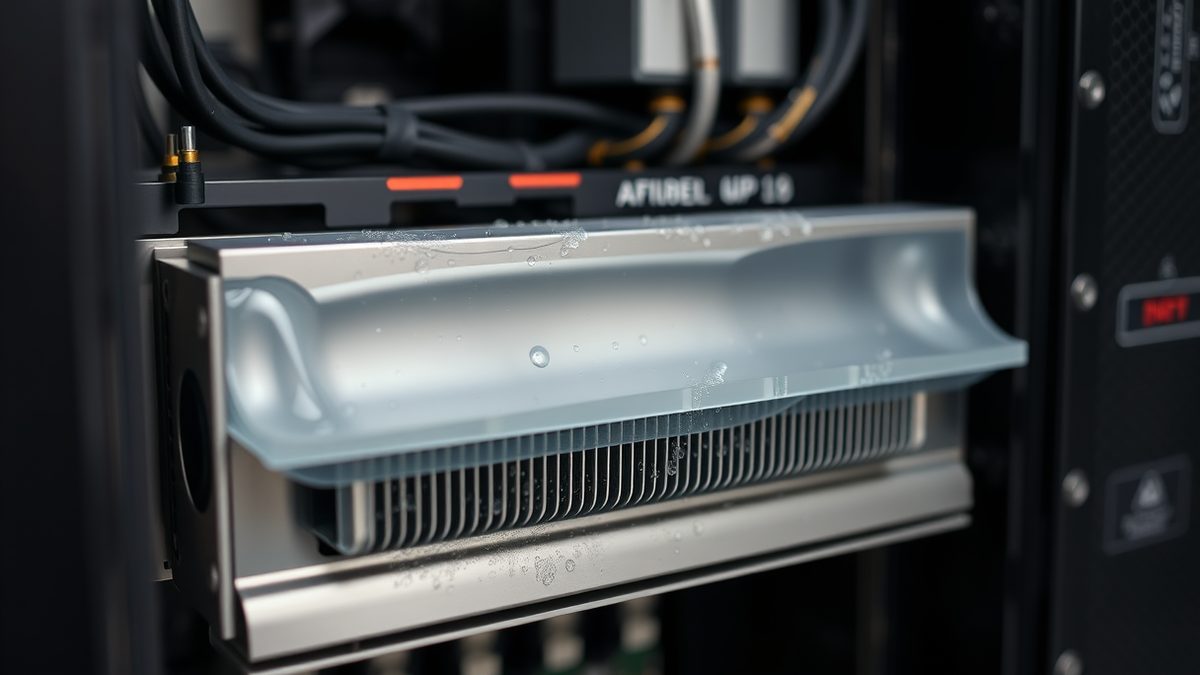
Chemours puts two-phase fluids on the market
The portfolio covers two-phase direct-to-chip and two-phase immersion cooling. It includes five fluids: Faizeon 100, 110, 200, 220 and 500. Faizeon 500 is the former Opteon 2P50 dielectric fluid. Chemours now sells it for full-server immersion.
For operators, that means a second two-phase option alongside single-phase water systems. It also raises a sharper question: which racks in an existing hall to convert first? Chemours has published no prices. Retrofit cost and downtime stay site-specific.
Chemours is selling the fluids on heat removal, energy and water. It says systems designed for Faizeon can cut cooling energy. They can also nearly eliminate cooling-related water use, depending on design and conditions. The headline figure is thermal. In independent third-party testing, a two-phase direct-to-chip system using Faizeon 200 held a GPU up to 19 degrees Celsius lower than a single-phase, water-based fluid. It did so at a lower coolant flow rate. Denise Dignam, Chemours' president and CEO, said cooling is becoming a critical constraint on AI growth. She said the company is applying more than 90 years of thermal management expertise to the problem.
Why two-phase, and why now
The timing is about wattage. Dell'Oro Group projects that leading-edge GPUs will exceed 4,000 W of thermal design power by 2029.
Single-phase direct liquid cooling handles most liquid-cooled capacity today, according to Dell'Oro. The firm expects two-phase direct liquid cooling to accelerate. Chip power and heat flux are exceeding what single-phase systems can practically manage. Dell'Oro also forecasts the data centre liquid cooling market at roughly $7 billion in manufacturer revenue by 2029. Rack density is moving the same way. NVIDIA's MGX 1.2 specification supports racks up to 250 kW. The OCP community sees a path to 1 MW racks. The International Energy Agency found data centre electricity demand rose 17% in 2025. That compared with 3% growth in global power demand. It expects data centre electricity use to double by 2030.
Two-phase cooling works by letting a refrigerant boil at the chip surface. The refrigerant carries heat away as vapour. Austin-based Accelsius says its NeuCool two-phase direct-to-chip platform can cool more than 4,500 W per socket.
The retrofit problem the fluids do not solve
A hall can have no liquid plumbing. None of that chemistry helps an operator there.
Installing liquid cooling is relatively easy in a new build. Designers can account for piping, rack loads, redundancy, heat rejection and maintenance access from the start. Retrofitting is harder. Liquid systems need supply and return lines close to servers. Existing server rooms are already crowded with networking and power cabling. Fixing that can mean repositioning racks, reworking cable pathways or creating new coolant routes. In some cases it means expanding white space.
Weight is the second constraint. In AI-heavy environments, fully loaded racks can exceed 3,000 pounds. That is a problem for the raised floors common in older halls.
Mechanical plant may need work too, from pumps and heat exchangers to water loops and dry coolers. Structural modifications, mechanical upgrades and rack-level changes can take months. Downtime is hard to avoid even when no major building work is required. That is manageable for operators with spare capacity elsewhere or the ability to burst into the cloud. It is much harder for mission-critical sites. Many colocation providers have chosen a workaround: partial deployment. They liquid-cool only the highest-density racks, which limits structural change and downtime risk.
Rack-scale hardware is already shipping
The equipment side is already at rack scale.
At OCP 2026, Cooler Master showed a 2.5 MW in-row CDU. It separates facility water from the IT coolant loop. Centralised management supports up to 32 interconnected units. Cooler Master also has a 300 kW air-assisted liquid cooling system for sites without dedicated water infrastructure. It is built around modular radiator racks and hot-swappable components. Vertiv's SmartIT combines power distribution, direct-to-chip liquid cooling, rack infrastructure and monitoring. It is a factory-validated platform, available globally. SmartIT supports NVIDIA GB300 NVL72, Vera Rubin NVL72, DGX Rubin NVL8 and HGX Rubin NVL8 systems on MGX and OCP ORV3 architectures.
ASRock Rack's version of the Vera Rubin NVL72 rack carries 18 compute trays and nine NVLink 6 switch trays. It also carries 36 Vera CPUs and 72 Rubin GPUs, all liquid-cooled. Four 110 kW power shelves feed it.
What happens next
The planning deadline is Dell'Oro's 2029 horizon. Dell'Oro projects leading-edge GPUs will pass 4,000 W by then. Vertiv demonstrated SmartIT with an NVIDIA HGX Rubin NVL8 unit at NVIDIA GTC Berlin in October 2026. Cooler Master is expanding production capacity in Vietnam alongside manufacturing in China.
Sources
16- 01Two-phase liquid cooling solution - Climate Control NewsEN
- 02As AI Chips Near 4,000 Watts, Liquid Cooling Becomes the Backbone of Data Center Design - MarketScaleEN
- 03Liquid Cooling Retrofits: Hard, but Sometimes Worth ItEN
- 04Liquid cooling retrofits complex for existing data centers - ET DatacentersEN
- 05OCP 2026: Cooler Master Scales Liquid Cooling from Cold Plates to 2.5 MW CDUs - Data Center FrontierEN
- 06Vertiv Introduces SmartIT Platform with Liquid Cooling for AI Data Centers - RefindustryEN
- 07Liquid-Cooled NVIDIA Servers at the ASRock Rack OCP 2026 BoothEN
- 08Liquid Cooling Is Changing What Data Centers Need to MeasureEN
- 09 China deploys 'world's first' 800-volt DC power system for massive AI data center EN
- 10UK’s most polluting power plant could power country’s largest AI datacentreEN
- 11Tutor Intelligence raises Series B to scale model training, robot deploymentsEN
- 12AI Data Centre Cooling Gets Aerospace-Grade Thermal Buffer - Urban AcresEN
- 13ARIA’s Scaling Inference Lab Deploys Lumai’s Optical Compute TechEN
- 14 Astronauts deploy solar array on 100th US spacewalk by International Space Station crew members EN
- 15CATL signs deal with Germany's Intilion to deploy 3 GWh of sodium-ion storage over 5 yearsEN
- 16Can Evaporative Cooling in Data Centers Still Make Sense?EN
All figures and quotations in this text come from the sources listed below.
Content prepared by the editorial team with AI assistance.
Rachel Nwosu
Comments
0- No comments yet — be the first.