Dell takes AI server lead as memory costs push Huawei buyers to the black market
Hyperion Research reported on 3 November that on-premises HPC and AI-for-science server revenue rose 19.9% in the first half of 2026 from the second half of 2025. Dell took the market-share lead with $4.2 billion, ending more than 25 years of HPE leadership.
 Dr. Amara PatelEconomy, business and world
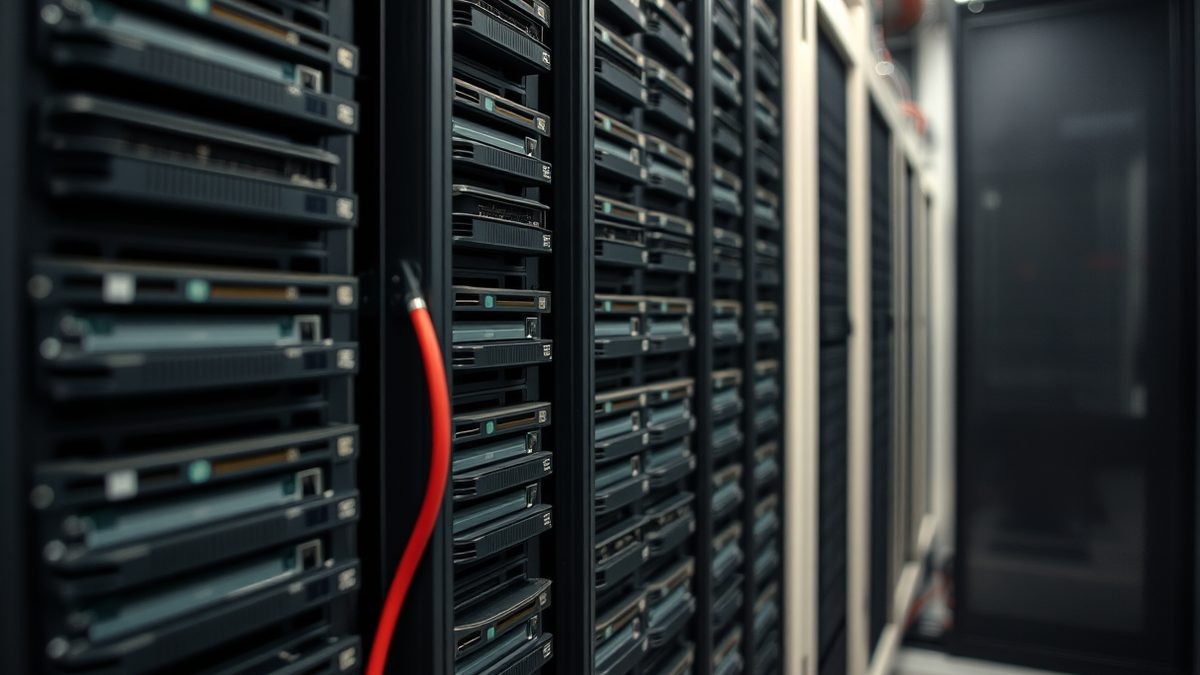
Dell takes the lead as AI server revenue jumps
The firm puts market growth close to 20% year on year.
Unit sales grew just 4.4% over the same period. Buyers are paying more per machine, not buying many more of them, and that changes the arithmetic for anyone budgeting an AI cluster this year. Hyperion attributes the gap to growing GPU content in systems and higher memory costs. Dell took the market-share lead with $4.2 billion in server revenue in the first half of 2026, ending a run of more than 25 years at the top for HPE. Hyperion credited large procurements and a fast-growing segment of mid-range AI-focused machines, bought to add AI to scientific and engineering workflows. HPE had recognised significant revenue in 2025 from multiple exascale-class machines, and Hyperion noted that scale of procurement is not realistic every year.
Earl Joseph, chief executive of Hyperion Research, said replacement demand and AI adoption are both driving spending. "Organizations and institutions are continuing to invest in their advanced computing infrastructure due to both replacing aging machines and the desire to adopt AI into their workflows to support their businesses and missions," he said.
Why AI systems cost more
Memory is where the pressure concentrates. Huawei is telling some customers to source memory for its AI chips themselves, according to The Information, as reported by The Decoder.
Prices for smuggled HBM3E memory have jumped from a few hundred dollars to around $4,000 per unit in a year, according to a Shenzhen broker. Each AI chip needs six to eight units, so the memory alone can cost up to $32,000. That shifts risk onto buyers. A customer sourcing HBM independently has to account for where it came from.
Black market fills the HBM gap
Its Chinese suppliers cannot produce enough high-bandwidth memory, and U.S. export rules block direct purchases from Samsung and SK Hynix. Those two companies control more than 80% of the global market.
Smugglers bundle HBM with cheap server processors whose performance falls below the export threshold, then ship the packages to China through Hong Kong. Workshops there separate the memory chips from the processors. The process is fragile and the error rate is high, The Decoder reported, but the margins make it worth it. The black market does not run on smuggling alone. Older Nvidia GPUs stripped for parts and excess inventory from scrapped projects also feed supply.
South Korea's customs authority had uncovered trade violations worth $560 million by May, already above the previous full-year record. A third of that total involved strategic goods. Those included chips exported without proper authorisation or with false declarations.
South Korea told to defend chip profits
Samil PwC, the South Korean member firm of PwC, published a report on Monday. It said Chinese competition would likely heat up first in conventional memory, mature-node manufacturing, and packaging and testing. The firm urged South Korean chipmakers to sharpen cost competitiveness in commodity memory while doubling down on advanced packaging and high-bandwidth memory. The warning is about mix as much as volume. Chinese rivals are scaling up production and market share, while the report says Korean firms should double down on advanced packaging and HBM.
Longer term, the industry expects AI to reshape how chips are designed. Cambricon co-founder Chen Yunji made a prediction at a science forum in Shanghai. Over the next 10 years, he said, AI models would improve AI models and AI chips would improve AI chips. The South China Morning Post reported the remarks.
What happens next
The near-term test is the Ascend 960DT. Huawei says it will double the performance of its current chips when it launches early next year. Whether customers can source memory for it at a workable price is a separate question, and one the company has pushed onto them.
Sources
20- 01Hyperion Research: Nearly 20% Growth in HPC and AI-for-Science Server Market, Dell Takes Lead from HPEEN
- 02Huawei tells customers to find their own AI chip memory, effectively outsourcing procurement to the black marketEN
- 03South Korea urged to guard chip profitability as China's CXMT and YMTC gain market shareEN
- 04AI, fuelled by advanced chips, set to power semiconductor manufacturing: industry veteranEN
- 05Blue Hydrogen Market to Grow at 57.64% CAGR Through 2031 Driven by Carbon Capture | Mordor IntelligenceEN
- 06 Google reveals new Gemini 4 Carbon AI model, narrowly beating Claude Opus 5.5 EN
- 07The ETS Investment Engine: Scaling Europe’s Strategic E-fuel Market for Shipping & AviationEN
- 08Germany’s Hydrogen Pipeline Reached Marl. Its Market Still Needs to Add Up.EN
- 09Global EV battery market share in January-September 2026: CATL 39.1%, BYD 15.2%EN
- 10Beyond the follower count: What the world’s most marketable athletes have in commonEN
- 11Google announces Gemini 4 Carbon, its latest frontier AI model that you can't useEN
- 12EU-UK ETS linkage, allowance supply dynamics shape European carbon market outlook: Carbon Forward LondonEN
- 13Official Claude Code Extension on Cursor Marketplace Trojanized with Persistent SSH BackdoorEN
- 14Google's Gemini 4 Carbon Leads Benchmarks for Finding, Exploiting, and Patching VulnerabilitiesEN
- 15Tencent targets Southeast Asia as launch pad for AI agent WorkBuddy amid tough local marketEN
- 16Aryna Sabalenka named world’s most marketable athlete in 2026EN
- 17How we compiled the 50 Most Marketable Athletes of 2026EN
- 18Five things to know about this year’s 50 Most Marketable AthletesEN
- 19Aryna Sabalenka’s rise from undervalued talent to most marketable athleteEN
- 20Apple iPhone Duo price premiums evaporate in China’s scalper marketEN
All figures and quotations in this text come from the sources listed below.
Content prepared by the editorial team with AI assistance.
Dr. Amara Patel
Comments
0- No comments yet — be the first.