Figure melts down its F.02 humanoid fleet in a Finnish arc furnace
Figure retired its remaining Figure 02 humanoids on 1 October by jumping them into a 75 tonne electric arc furnace in Imatra, Finland, and is selling souvenir metal from the melt for $500 and $1,900. The company says keeping the older robots running was too expensive.
 Grace OkonkwoAI, models and technology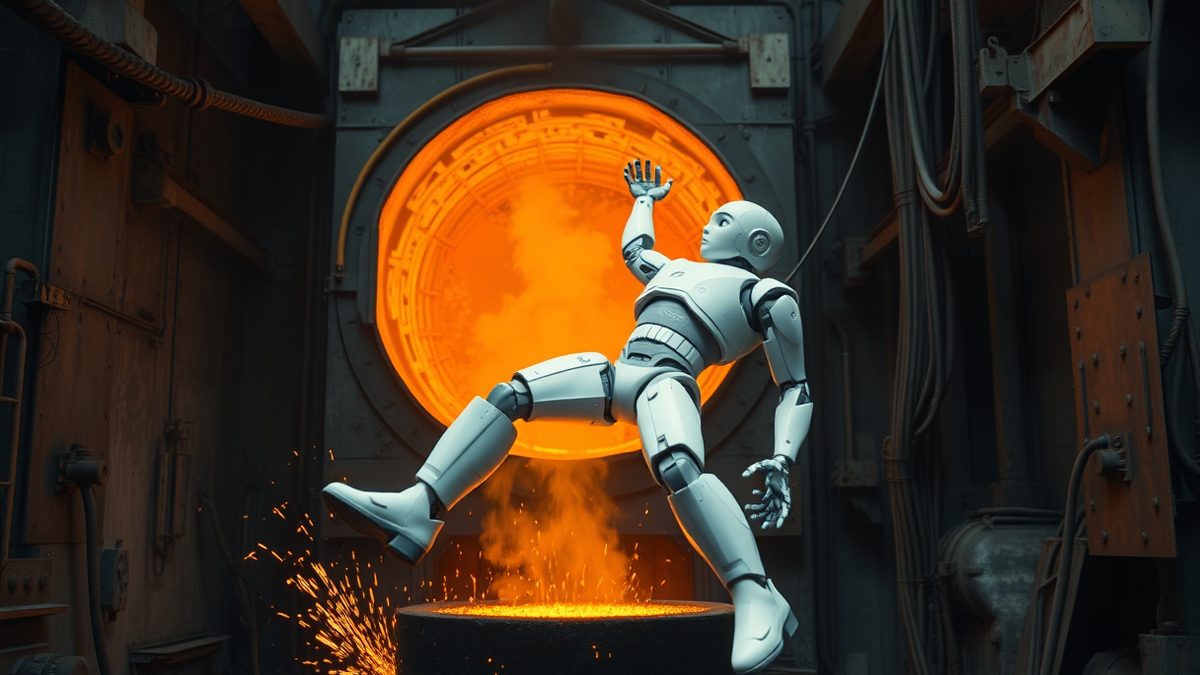
Figure has retired its remaining Figure 02 humanoids by dropping them into a 75 tonne electric arc furnace at a foundry in Imatra, Finland. German tech outlet heise online reported the disposal on 1 October. The company says keeping the F.02 fleet operational was too costly. Dismantling the robots by hand, Figure argues, would have taken time it wants to spend on the next generation, the F.04.
Arnold Schwarzenegger appears in the video, lowering one robot into the furnace on a chain in a sequence lifted from Terminator 2. Other units walked and somersaulted into the vessel on their own. Former members of the television show MythBusters helped plan and shoot the exercise, according to heise. Figure has not said how many units it shipped to Finland; heise reports that a few stayed at the company's San Jose headquarters. The disposal was not straightforward. heise reported that plant operators in the United States and Mexico refused the job, partly because the robots carried lithium-ion batteries. The robots needed those batteries to perform the jump. A foundry in Imatra eventually agreed to take the project.
Metals, souvenirs and a marketing video
Figure brought the melted material back to the United States. The company is taking pre-orders for commemorative pieces made from it at $500 for the small version and $1,900 for the larger one. That detail, and the training programme behind the jumps, comes from heise's write-up of the video posted by Figure chief executive Brett Adcock.
The choreography was rehearsed. Jump routines were first trained in simulation at Figure's San Jose site, using stunt performers' movements as reference. The company then ran the jumps with real robots into an air cushion before attempting the furnace. The robot that Schwarzenegger lowers does the Terminator 2 thumbs-up as it sinks.
Figure is not the only company with a humanoid in the field, and the wider numbers are worth keeping in view. The International Federation of Robotics said on 24 September that the global operational stock of industrial robots rose 9% to a record 5 million units in 2025, after factories installed more than 600,000 new machines during the year. Humanoids remain a rounding error inside that total.
China is where the early volume sits. TechNode reported on 29 September that China shipped more than 19,000 humanoid robots in the first half of 2026, 77.9% of global shipments, citing IDC figures. Global shipments reached nearly 25,000 units, up 432.1% year on year. IDC raised its 2030 forecast to more than 750,000 units.
The Optimus problem next door
Tesla, the other company with a mass-market humanoid bet, is having a harder time than the shipment figures suggest. Ars Technica reported on 26 September, citing extensive reporting by The Information, that Tesla's Fremont factory stopped building the Model S and Model X in May 2026 and moved line workers and engineers onto Optimus.
The newest version, Optimus V3, has proven difficult to build. Production line equipment struggles to align components precisely and the line cannot run fast enough. Tesla has reportedly scaled to hundreds of robots per week and is targeting more than 1,000 per week by the end of 2026. Workers must assemble hands and forearms containing more than 100 small parts such as screws by hand, and freshly built robots need immediate fixes. Touch sensors for the hands proved unreliable enough that Tesla developed a replaceable glove-like sensor layer instead of swapping entire hands.
There is a labour angle too. The Information's reporting, relayed by Ars Technica, describes employees pushing back against training their robotic replacements. One source described the current Optimus as requiring programming for specific tasks in carefully controlled environments.
The data problem behind that is not unique to Tesla. Innodata opened a motion-capture laboratory on 30 September to generate training data for humanoids and industrial robots, The Robot Report wrote. Franklin Tanner, the company's vice president of robotics and physical AI, said robots lack the equivalent of the internet's text corpus: "Physical AI has to earn its tokens one interaction at a time, and they have to be deliberate." Innodata captures 3D motion directly from human or mechanical bodies rather than inferring it from 2D video.
Sensors, safety and the form factor argument
Component suppliers are positioning for the build-out. Vishay Precision Group will present custom force and torque sensing for humanoids at RoboBusiness 2026, The Robot Report wrote on 1 October. Ron Zukerman, the company's innovation director, said in the announcement that VPG focuses on "precision sensing solutions exactly where they are needed most: at the key points of performance, safety, and control in today's advanced intelligent systems." The show runs on 20 and 21 October in Santa Clara, California.
ForceN will run a session at the same event on force and torque sensing for humanoids, The Robot Report reported on 29 September, drawing on the company's work with humanoid developers over three years. The pitch is straightforward: without force sensing, a robot cannot tell how hard it is gripping.
Not everyone is convinced the legs are necessary. Maven Robotics chief executive Hamza Derbas told The Robot Report on 1 October that humanoid companies "were starting with the human form factor and trying to work backwards into a problem to be solved." Maven builds a wheeled mobile manipulator with a small footprint, 3 m of vertical reach and 30 kg payloads, and says it has robots running 16 hours a day, five days a week, at up to 99% uptime.
Bruno Siciliano, a robotics professor at the University of Naples Federico II, made a similar point in Il Sole 24 Ore on 1 October. He cited BMW's rethink of its use of Figure AI robots at its South Carolina plant and argued the fully anthropomorphic version is not always productive in a factory, for reasons of cost, stability and movement in tight spaces. Siciliano also flagged the risk of a bubble, saying there is not currently an adequate return on investment.
That is the tension the sector has to manage. Figure can afford a marketing stunt in Finland and a souvenir business on the side. Tesla is trying to convert car lines into robot lines and finding that hands, sensors and training data are the hard parts. Between them sits a supply chain that mostly sells to factories today: five million industrial robots at work, and humanoids still measured in tens of thousands of shipments, most of them in China.
Sources
11- 01Figure mustert humanoide F.02-Roboter aus und lässt sie in Schmelzofen springenDE
- 02Five Million Robots now Operate in Factories GloballyEN
- 03China accounts for 77.9% of global humanoid robot shipments in H1, IDC saysEN
- 04Tesla workers balk at training Optimus humanoid robots as replacementsEN
- 05Innodata opens motion-capture lab to help humanoids move more like peopleEN
- 06Vishay Precision Group (VPG) to Showcase Custom Sensing Capabilities for Humanoid Robotics at RoboBusiness 2026EN
- 07ForceN to give a crash course on force and torque sensing for humanoids at RoboBusinessEN
- 08How Maven Robotics plans to automate industrial work, one task at a timeEN
- 09Umanoidi, il professore di robotica Bruno Siciliano: «L'Ue punta sull'interazione tra uomo e macchina»IT
- 10Memory At The Edge: Non-Volatile Memory Challenges And Requirements For Humanoid RobotsEN
- 11State of Robots in ManufacturingEN
All figures and quotations in this text come from the sources listed below.
Content prepared by the editorial team with AI assistance.
Grace Okonkwo
Comments
0- No comments yet — be the first.