Google's Suncatcher satellite launches Oct 1, cooling limits runs to 15 minutes
Google will launch its first orbital AI data centre test on 1 October. The refrigerator-sized satellite carries four TPU chips that run for about 15 minutes before the cooling system must catch up, Ars Technica reported on 24 September.
 Grace OkonkwoAI, models and technology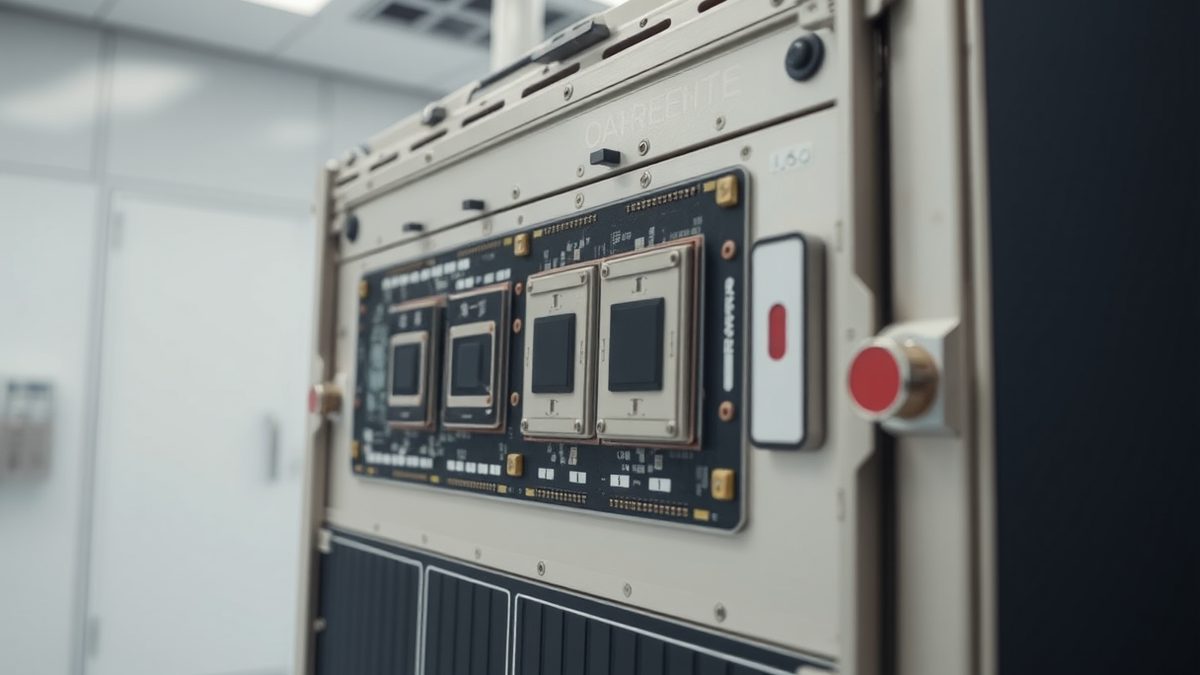
Google will launch its first orbital AI data centre test on 1 October. The satellite, named MVP, is refrigerator-sized. Its four TPU chips can run for about 15 minutes at a time before the cooling system has to catch up, Ars Technica reported on 24 September.
MVP rides a SpaceX Falcon 9 as part of the Transporter-18 rideshare, Ars Technica says. It carries four of Google's custom TPU accelerators and solar panels supplying about one kilowatt, according to The New York Times, which Ars Technica cites. On the ground, a data centre runs thousands of those chips.
That power budget is the whole story of the test. One kilowatt is roughly what a microwave draws. Google is not testing scale. It is testing whether off-the-shelf AI silicon survives orbit at all.
Heat is the hard part
Cooling is the constraint everyone keeps pointing at. In space there is no air to blow across a heatsink. So Google's design uses a layer of malleable thermal interface material that connects the chips to aluminium and copper heat pipes. These conduct heat into a radiator that projects it into space. Ars Technica describes the approach in detail. The result: brief runs of about 15 minutes, then a shutdown while the radiators catch up.
Radiation is the other problem, and a messier one. Space radiation can flip bits inside a chip and change the result of a calculation. Google's answer for now, per Ars Technica, is to restart the chips periodically to reset them. Vibration and high g-forces during launch are additional risks the team will watch. The TPUs are the same hardware Google uses in terrestrial servers, not radiation-hardened parts.
Tom's Hardware reported on 26 September that the satellite will handle AI requests for up to a year while remaining in orbit for up to six years. After that, it burns up on re-entry. The spacecraft itself was not built by Google. It comes from satellite imagery firm Planet Labs. Ars Technica notes the initial plan had been two custom satellites in 2027 before Google chose to accelerate by integrating its chips into an existing Planet Labs platform. Google will run Gemini models on the chips for testing.
Fifteen years, by Google's own estimate
Google's own framing is notably unexcited. James Manyika, the company's senior vice president of research, told The New York Times: "We don't expect, to be perfectly frank, that we'll have anything usefully operational in the next few years." He compared the venture to Google's driverless cars, which the company was testing "like 15 years before anything showed up."
Long-term plans, per Tom's Hardware, include a pair of satellites next and eventually networked fleets of more than 80 satellites. Ars Technica reports the 2027 launches remain on the agenda but that the team expects years before Suncatcher becomes a product rather than a project. Musk, Bezos and Sam Altman have all floated orbital data centres. China has already put AI compute in orbit, and Intel holds a patent on the idea.
Why bother? Because terrestrial data centres are fighting their neighbours. WIRED's Molly Taft reported on 27 September that a Climate Week panel on AI and data centres was interrupted repeatedly by Extinction Rebellion NYC protesters. Public opinion on data centres is at rock-bottom levels, with moratoriums appearing in red and blue states. Cully Cavness of Crusoe and Varun Sivaram of Emerald AI spent the session arguing that data centres can be "good citizens" on the grid. The audience was not buying it.
Two days earlier, on 25 September, Crusoe itself walked away from a turbine deal that would have powered its AI campuses. TechCrunch reported that Crusoe ended a plan to spend $1.25 billion on 29 of Boom Supersonic's 42-megawatt Superpower turbines, with first deliveries due in 2027. Boom CEO Blake Scholl announced the split in a post on X. Crusoe spokesperson Andrew Schmitt told TechCrunch the company's energy plans "haven't changed" and that it still intends to use turbines, "just not Boom's." Boom says it will deliver about 250MW of Superpower units next year to other sites and targets 1GW in 2028. The two accounts are not the same account, and TechCrunch prints both.
Ground truth in New Jersey
The cooling and power argument is not only a space argument. In New Jersey, Ars Technica reported on 24 September that the state fined DataOne $1.1 million. An investigation by The Guardian and Floodlight News used thermal drone footage to show 45 of 62 gas generators operating without permits. The generators ran at 1,982-kw capacities, more than 50 times the state threshold that requires a permit. DataOne has 45 days to apply for permits or cease operations, but can keep running the engines while it applies.
DEP Commissioner Ed Potosnak called it "by far the largest ever taken against a data center in New Jersey." Residents were less impressed. "What's $1.07 million?" Tiffany Leone-Vespa told The New York Times. "They should have done it for each generator they were running, illegally."
Outside the US the same fight is being relabelled. The Guardian reported on 26 September that Australian officials and industry figures argue the country's data centre backlash is a faux import from America. Belinda Dennett of Data Centres Australia said the US has 5,400 data centres with 53.7 gigawatts of capacity against 252 in Australia with 1.4 gigawatts. The Guardian notes what Dennett omitted: per head of population, Australia has just under one data centre per 100,000 people against 1.5 in the US. Victoria's then-minister for economic growth, Steve Dimopoulos, said: "We are not the United States."
And in India, the Guardian reported on 26 September, villagers in Tarluvada say land was taken for a Google hyperscale AI data centre announced publicly as 1GW, while state environmental clearances allow 2.51GW. Google referred to it only as an unspecific "gigawatt scale AI hub." Three petitions are before the National Green Tribunal. Google has partnered with the Adani Group on the project.
Put together, the pattern is the same in orbit and on the ground: the compute is easy to specify and the heat is not. Google's satellite will spend most of its year switched off, waiting to cool.
Sources
7- 01Google's first Suncatcher orbital data center test launches October 1EN
- 02Google's orbital AI data center test packs four TPUs and 1,000W of solar powerEN
- 03Crusoe abandons $1.25B plan to use Boom turbines at AI data centersEN
- 04New Jersey fines data center $1.1M after drone pics expose 62 gas generatorsEN
- 05The Data Center Backlash Should Also Be a Climate Reckoning. It Isn't YetEN
- 06Australian backlash to datacentres is faux import from US, officials sayEN
- 07Broken promises, confiscated land: the hyperscale AI datacentre being built in a tiny Indian villageEN
All figures and quotations in this text come from the sources listed below.
Content prepared by the editorial team with AI assistance.
Grace Okonkwo
Comments
0- No comments yet — be the first.