Humanoid robot factories: five million industrial robots, one wheeled surprise
The global stock of factory robots hit a record 5 million units in 2025, the International Federation of Robotics said on 24 September, while Agility Robotics confirmed on 25 September it is exploring wheeled robots alongside its Digit humanoid.
 Rachel NwosuAI, models and technology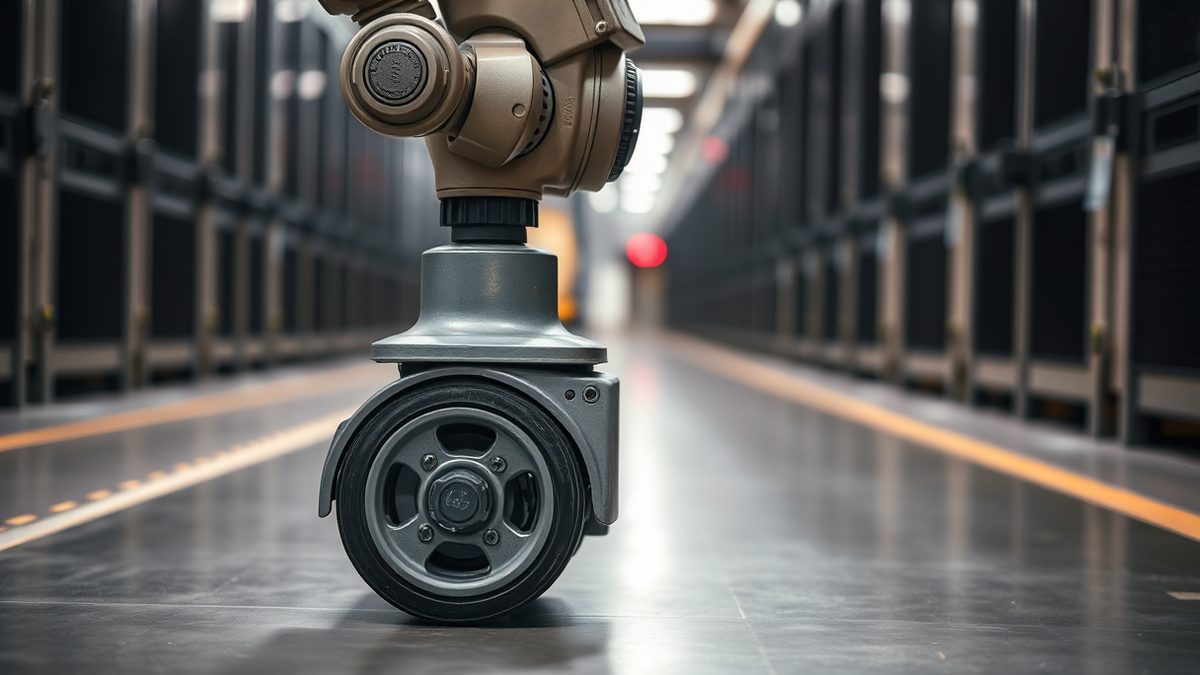
Factories worldwide ran 5 million industrial robots in 2025, up 9%, after installing more than 600,000 new units, a jump of 11%, according to the International Federation of Robotics. The Frankfurt-based group published the figures on 24 September, and The Robot Report carried them the same day.
China drove most of that growth. Installations there rose 20% to 354,000 units, or 59% of global deployments. The IFR says Chinese suppliers sold 195,000 units at home, more than foreign vendors did, for a 55% domestic share, down from 57% in 2024.
Two days later, a different question surfaced: what shape should these machines be? Agility Robotics, the Oregon company behind the Digit humanoid, told The Robot Report on 25 September that it is looking at wheels. A wheeled robot had appeared near the end of Agility's Digit 5 launch video.
"We're exploring a range of robot designs and form factors, including wheels, to address different operating environments and customer needs," CEO and chief robot officer Jonathan Hurst said by email.
That is a notable position for a company built on legged locomotion, the technology Hurst has researched for decades. The Robot Report notes that Agility already broke with its own design language on Digit 5, dropping the backwards-bending knees of earlier versions. Hurst said it was "too early to say" whether a wheeled product would be a new Digit variant or a different robot, and gave no timeline.
The commercial context matters. Agility is going public through a SPAC with Churchill Capital Corp. XI, a deal that values it at $2.5 billion and is expected to raise more than $620 million in gross proceeds. Its S-4 filing showed $1.8 million in 2025 revenue against a $140 million operating loss, plus more than $300 million in multi-year Digit v5 orders from a single customer.
Tesla is having a harder time. Ars Technica reported on 26 September, citing extensive reporting by The Information, that Tesla has scaled Optimus production to hundreds of robots a week while targeting more than 1,000 a week by the end of 2026. The report describes hands and forearms assembled by hand from more than 100 small components such as screws, touch sensors that do not work reliably, and workers who pushed back on wearing motion-capture suits because they knew the robots were designed to replace them.
Toyota, by contrast, frames its automation as coexistence. Ars Technica reported on 23 September that the company plans to invest $6.42 billion a year from 2028 in factory robots, aiming for 150,000 in its own plants and 250,000 more at group facilities. Executive vice president Hiroki Nakajima told Nikkei Asia the goal is "a world where robots coexist with humans, rather than replacing them."
Not everyone is building at automotive scale. O-ID, a Tokyo company founded in 2025 by Norwegian CEO Stian Jakobsen and Dutch CTO Simon Gormuzov, raised $1.2 million in pre-seed funding led by Chicago-based TAWANI Ventures, Tech.eu reported on 24 September. It is building modular humanoids for manufacturing and logistics, with factory pilots planned for 2027, and argues that a single failed component should not sideline an entire robot.
Research is moving in parallel. On 27 September, The Decoder reported that Stanford and Caltech researchers built HomeBody, a system that lets a Unitree G1 robot tidy an unfamiliar kitchen using GPT-6 Astra as a vision-language model that calls directly into a skill library for grasping, navigating and opening drawers. The reported limits: latency, overheating finger servos and high compute costs.
The IFR expects installations to rise 9% to 655,000 units in 2026 and reach 806,000 in 2029. Its president, Jane Heffner, called the 5 million mark more than double the figure of seven years ago, with Asia growing fastest and Europe slower.
Sources
7- 01Five Million Robots Now Operate in Factories GloballyEN
- 025 million robots are now at work in factories worldwide, reports the IFREN
- 03Agility Robotics, maker of Digit humanoid, exploring wheeled robotsEN
- 04Tesla workers balk at training Optimus humanoid robots as replacementsEN
- 05Toyota orders workers to train humanoid robots but says humans won't be replacedEN
- 06Europeans in Japan raise $1.2M to put modular humanoid robots to workEN
- 07Researchers plug GPT-6 Astra directly into a robot and let it clean up an unfamiliar kitchenEN
All figures and quotations in this text come from the sources listed below.
Content prepared by the editorial team with AI assistance.
Rachel Nwosu
Comments
0- No comments yet — be the first.