The race for charging power: Geely at 2.25 MW versus BYD at 1.5 MW and 2,000 stations
Geely has unveiled a charging system with a peak output of 2,250 kW and a 12C battery. BYD already runs 2,000 fast-charging stations on motorways, while NIO has close to 9,500 battery swap and charging points.
 Daniel FisherSport, cars and travel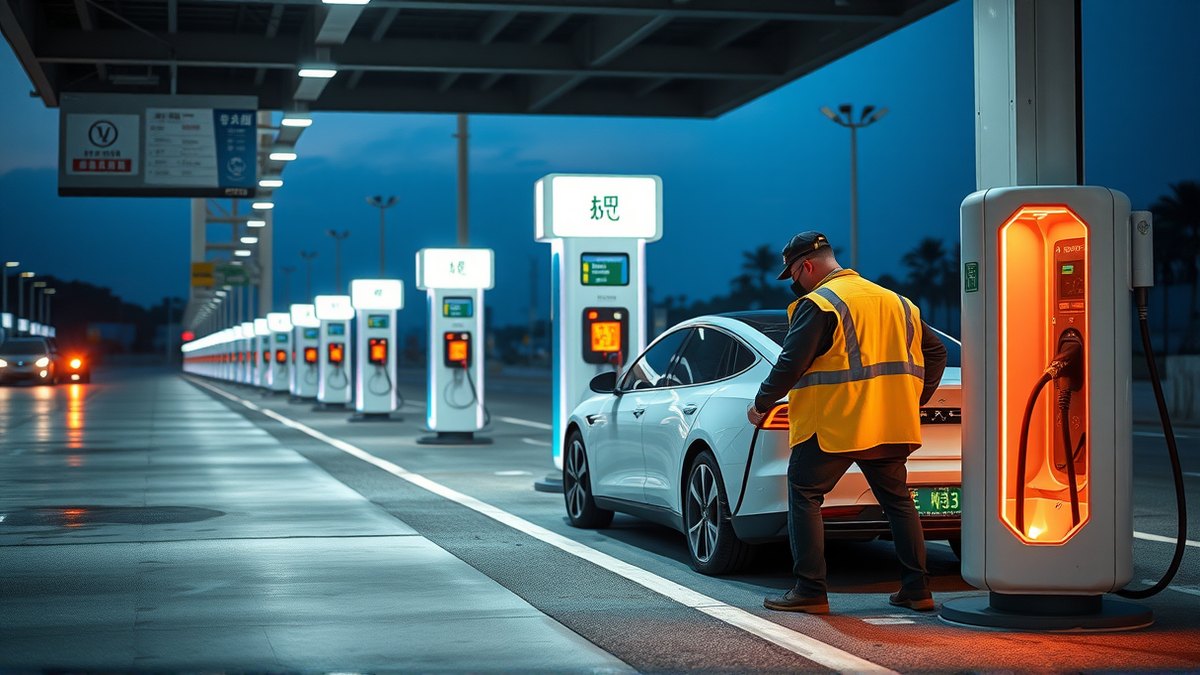
China's charging market has entered a race for record power levels. In Ningbo, Geely presented the fifth generation of its Geely Smart Charging station, which is to reach a peak output of up to 2,250 kW (2.25 MW). That beats the BYD Flash Charging column shown in March, which delivers a maximum of 1,500 kW through a single connector, electrive reports.
The station's power is not the key part, though. What matters more is the cell it is paired with. Geely combines it with the "Shendun Golden Battery", built for ultra-fast charging at a maximum rate of 12C. In tests, the Lynk & Co 10 and Zeekr 001 with that cell charged from 10 to 70 percent in 4 minutes and 30 seconds, and to 97 percent in 8 minutes and 40 seconds. That is slightly faster than the figures BYD gives for the second generation of its Blade battery, which with the Flash Charging system also counts as a record holder.
Motorways: 2,000 BYD stations
At the same time, another question is being settled: whether charging on the road is ceasing to be a bottleneck. On 24 September 2026 BYD announced on Weibo that it had completed its 2,000th fast-charging station on motorways, three months ahead of schedule and before the holiday travel peaks. The plan announced on 5 March assumes 20,000 stations by the end of 2026, including 2,000 on motorways. By the end of August the company had built 10,000 points.
The motorway stations cover close to one third of China's service areas, and the average gap between them is a little over 100 km. Queues for charging have for years been one of the main worries for Chinese electric car drivers on long routes. Shortening the gaps matters as much as shortening the charging itself.
NIO bets on battery swapping
NIO took a different route, expanding its battery swap network rather than charging alone. According to the company's data for 25 September 2026, 9,430 charging and swapping points are in operation across China, including 4,124 battery swap stations, 5,306 charging stations and 30,594 charging points. The same day NIO opened a station at the Kaiyuan Silk Road hotel in Huoerguosi, the westernmost point of its Silk Road route, which runs 3,605 km and includes 33 swap stations.
As a result, Chinese infrastructure is developing along two parallel models: ultra-fast charging (Geely, BYD) and swapping entire batteries (NIO). For Europe the signal is that expanding charger power alone, without changing battery architecture, will not solve the problem of downtime.
Sources
3- 01Geely counters BYD with 2.25 MW charging system (electrive)EN
- 02蔚来丝绸之路换电路线明日贯通,最西一站今日上线 (IT之家)ZH
- 03BYD reaches 2,000 highway flash charging stations, hitting target 3 months early (CnEVPost)EN
All figures and quotations in this text come from the sources listed below.
Content prepared by the editorial team with AI assistance.
Daniel Fisher
Comments
0- No comments yet — be the first.