GM and LG Put LMR Cells in Tennessee as Plug-In Batteries Wait for UK Rules
Ultium Cells, GM's joint venture with LG Energy Solution, said on 29 September that its Spring Hill, Tennessee plant will be the first in the world to mass-produce prismatic lithium manganese-rich (LMR) battery cells, an upgrade the company says adds 500 jobs and targets a chemistry it claims is 33% denser than LFP at comparable cost.
 Daniel FisherSport, cars and travel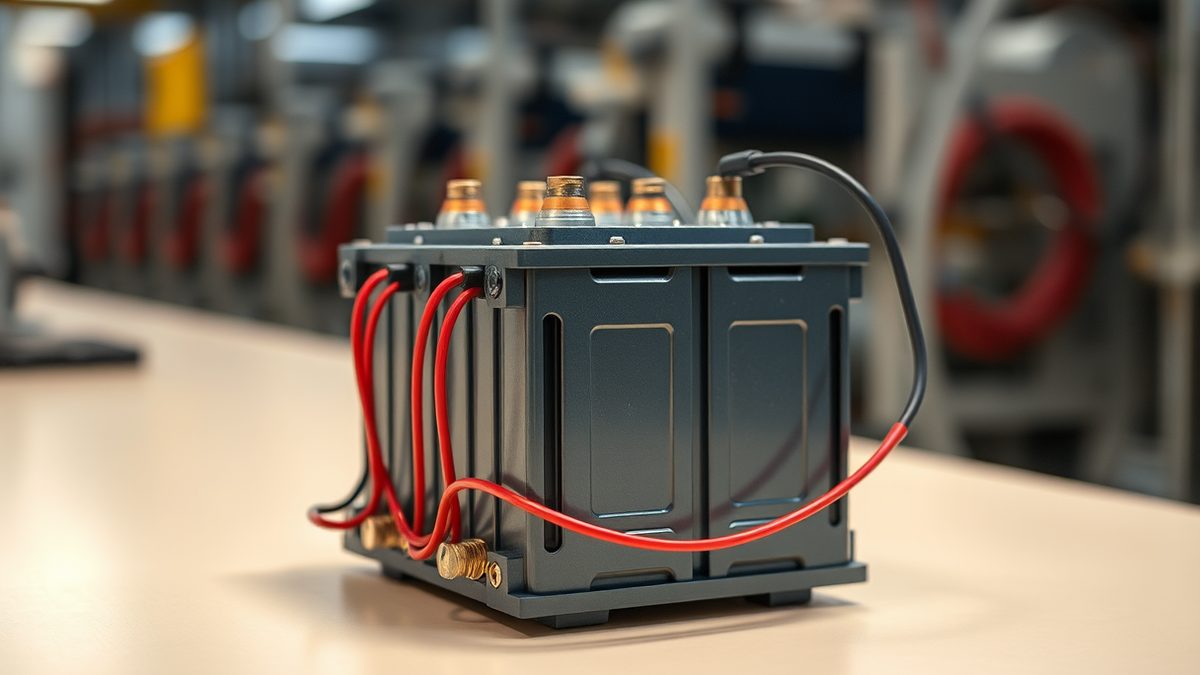
Ultium Cells, the joint venture between General Motors and LG Energy Solution, said on 29 September that the Spring Hill, Tennessee battery plant will be converted to make prismatic LMR cells, with upgrades starting later this year and finishing by 2028. GM says the site will be the first in the world to mass-produce that chemistry, and that the work adds 500 jobs, taking the plant to 1,700 workers, according to Electrek's write-up of the announcement.
That is the number to hold onto: 500 jobs, 2028, 33%. Ultium says LMR cells can deliver 33% higher energy density than lithium iron phosphate (LFP) at comparable cost. GM's vice president of battery and sustainability, Kurt Kelty, said in the same statement that "adding LMR positions us to leapfrog today's more affordable chemistries and deliver lower costs with better performance".
The timing is awkward but deliberate. The US federal clean vehicle credits ended on 30 September 2025, and the market has not recovered. The US Energy Information Administration, writing in its Monthly Energy Review and republished by CleanTechnica on 30 September, estimates light-duty electric vehicles consumed 8% more electricity in the first half of 2026 than in the second half of 2025, down from the 13% to 24% growth seen in recent six-month periods. New electric vehicle sales in 1H26 were down 19% compared with 2H25, the EIA said.
GM's own sales numbers make the same point more bluntly. Its third-quarter sales fell 5.5% to 670,974 vehicles, with the Equinox EV down 92.4% to 1,905 cars and the Blazer EV down 84.4%, according to The Next Web's report on the figures. Toyota sold 633,223 vehicles in the quarter, up 0.6%, leaving GM's full-year lead at under 136,000 vehicles against roughly 335,000 for the whole of last year.
Why manganese, and why now
LMR is not a new idea. CleanTechnica noted on 30 September that GM first floated the formula in March 2025, kept it alive through Ultium Cells while it pivoted some capacity to stationary LFP storage, and has now committed to the Spring Hill conversion. GM says its combined LFP and LMR investments will reach $2 billion by 2030.
The chemistry matters because manganese is abundant and cheaper than the nickel and cobalt in NMC cells. GM says LMR batteries will go into upcoming electric trucks and full-size SUVs with more than 400 miles of range, while high-nickel cells stay on the roster for maximum range. Its current longest-range EV, the Chevrolet Silverado EV, is rated at up to 478 miles and starts at $55,895.
Whether LMR can be built at scale is a separate question from whether it works in a lab. The BBC reported on 29 September on the wider push to bring battery making back to the US, including San Diego-based Unigrid, which sells a nine kilowatt hour sodium-ion home battery and has shipped 100 units, with 1,000 expected before the end of the year. Unigrid's cathode contains chromium-3, and Professor Dame Clare Grey at the University of Cambridge, co-founder of Nyobolt, told the BBC that under certain conditions chromium-3 may form chromium-6, a toxic, cancer-causing material. Ivana Hasa at the University of Warwick, who has no connection to Unigrid, said chromium-6 formation is possible at very high states of charge but can be mitigated by voltage control. Unigrid chief executive Darren Tan called the toxicity concerns "overblown" and said third-party tests could not produce chromium-6.
European legislators are watching the same supply chain from the other side. Transport & Environment published analysis on 30 September arguing that by 2030 the EU will have enough made-in-EU cells to cover vehicles falling under the Industrial Accelerator Act, provided all projects materialise, including medium-confidence ones. T&E said local content requirements for cells and cathode active materials could add 34% to EU battery demand in 2027 compared with the current baseline. Xavier Sol, the group's director of sustainable investments and batteries, said European industrial competitiveness "hinges on a simple question: will high value clean tech jobs come to Europe or remain in Asia?"
On the grid, the money is moving to smaller boxes
While carmakers argue about cells, the storage business is being reshaped by much smaller units. MIT Technology Review reported on 1 October that PopWheels runs about 50 battery-swap cabinets across New York City with about 2,500 batteries in circulation for delivery e-bike riders, and has started supplying food cart operators with packs that can supply five kilowatt-hours, roughly a day's operation for many carts. Copper is building induction stoves with integrated batteries; Every Electric and David Energy sell plug-in batteries for homes and businesses. James McGinniss, co-founder and CEO of David Energy, told a New York Climate Week event that this is "the biggest thing to happen in the power grid sector in the last 20 years".
David Hammer of PopWheels, speaking at the same event on 24 September, said the number-one challenge for large-scale centralised storage providers is that "their benefits are abstract and their costs are concrete". That tension is visible in Germany, where heise online reported on 1 October that the distribution network operator Mitnetz Strom has received more than 10,000 storage registrations this year and its managing director, Lutz Eckenroth, described a "tsunami" of applications and "gold-rush mood" among large-scale battery developers. Eco Stor is building 300 MW and 700 MWh at Förderstedt in Saxony-Anhalt, enough in theory to supply around 500,000 households for two hours. Its managing director, Georg Gallmetzer, told heise that "nine out of ten megawatts" currently applied for will never be connected. Mitnetz connected 33 large storage projects by the end of last year while 2,500 applications went unbuilt.
Insurance is starting to price the concentration risk. Olly Litterick, head of renewables at Tokio Marine GX, told ESS News, as reported by pv magazine on 1 October, that co-located solar-plus-storage sites now carry "hundreds of millions of dollars or even billions of dollars of exposure in a single location where multiple insureds share grid connection points". Litterick said a transformer failure or material damage at a shared export point can hit several insured projects at once, and that "the numbers can be astronomical". TMGX has about 8 GW of BESS insured participation, most of it still in construction.
Chemistry elsewhere: iron, lead and plug-in rules
Not every battery story this week is about cars. CIC energiGUNE in Spain said on 1 October that it has completed 10,000 charge-discharge cycles on an iron-lead redox flow battery, tested between 25 C and 30 C, using a single electrolyte loop and a fluorine-free membrane, according to pv magazine. The design uses iron and lead as active materials with established industrial and recycling supply chains, and the next step is kilowatt-scale modules.
Chinese manufacturer Marstek brought its 3 kW, 5 kWh Venus E 4.0 plug-in battery to Solar & Storage Live UK in Birmingham, pv magazine reported on 1 October. The unit uses 5,024 Wh of LiFePO4 storage, claims more than 10,000 cycles at 25 C, and is scalable to 9 kW and 15 kWh with the company's SmartBox. Daisy Jiang, key account manager at Marstek Energy, said the company is "working on deeper integration with Octopus Energy and other energy management providers". The catch is regulatory: the UK's plug-in solar rules introduced in August did not cover plug-in batteries, and the government has since launched a tender for a technical risk and safety assessment to inform future rules.
Meanwhile the Department for Transport published an analysis on 28 September comparing fuel pumps with public EV chargers. DfT took the number of public chargers as of 1 January 2026 from official statistics, then estimated fuel pumps by multiplying 8,329 petrol stations, from the Petrol Retailers Association's 2025 market review covering 11 November 2024, by an average of 7.3 fuelling positions per station, drawn from Deloitte's 2013 research for the RAC Foundation. That gives 60,802 fuel pumps. The department's conclusion: there are now considerably more public EV chargers than fuel pumps across the UK. The charger data carries the "official statistics in development" label, which DfT says does not meet the quality standards of accredited official statistics.
Heavy equipment is moving the same way. Hyundai launched the 16-tonne 160B-X and 18-tonne 180B-X battery-electric forklifts, completing a range from 4 to 18 tonnes, Electrek reported on 1 October. The 160B-X uses a 618V lithium-ion system and Hyundai claims more than seven hours of continuous operation per charge, with Raymond Galavazi, senior product manager at Hyundai Material Handling, saying customers across a wide range of industries "can now consider high-voltage electric trucks from 4-18 tonnes".
None of this settles the question GM is betting on. LMR cells are still three years from volume production at Spring Hill, and the American market they are meant for shrank the moment the $7,500 credit expired. Europe, where electric cars took 29% of new registrations in August and petrol costs about EUR 2.092 a litre on the EU weighted average, is running a different policy experiment entirely.
Sources
15- 01GM's new EV battery tech will cut costs without sacrificing performance or rangeEN
- 02GM Really Wasn't Kidding About Those New LMR EV BatteriesEN
- 03U.S. Electricity Use For Electric Vehicles Increasing At A Slower Pace In 2026EN
- 04GM's Q3 sales drop 5.5% as its electric models collapse and Toyota closes to within 136,000EN
- 05The start-ups hoping to return battery making to the USEN
- 06Ready to Scale: Europe Will Have Enough Cells to Meet Demand and Grow Its Domestic Battery Value Chain IndustryEN
- 07How smaller, distributed batteries could help the gridEN
- 08Batteriespeicher-Boom lockt SpekulantenDE
- 09Shared grid connections concentrate battery insurance riskEN
- 10Spanish researchers validate 10,000 cycles for iron-lead flow batteryEN
- 11A closer look at Marstek's 5 kWh plug-in batteryEN
- 12Comparing fuel pumps to electric vehicle public chargersEN
- 13E-quipment highlight: 16-tonne Hyundai 160B-X battery-electric forkliftEN
- 14Is The US Going To End DEAD LAST In Vehicle Electrification?EN
- 15Toyota dropped a 1,675 lb caravan on its electric truck, and it drove off unfazed [Video]EN
All figures and quotations in this text come from the sources listed below.
Content prepared by the editorial team with AI assistance.
Daniel Fisher
Comments
0- No comments yet — be the first.