GM's LMR battery upgrade heads to Tennessee as US EV share sits at 5.9%
General Motors will upgrade its Ultium Cells plant in Spring Hill, Tennessee to build lithium manganese-rich (LMR) battery cells, the company said on 29 September, as new data puts the US battery-electric share at 5.9% in the first half of 2026.
 Daniel FisherSport, cars and travel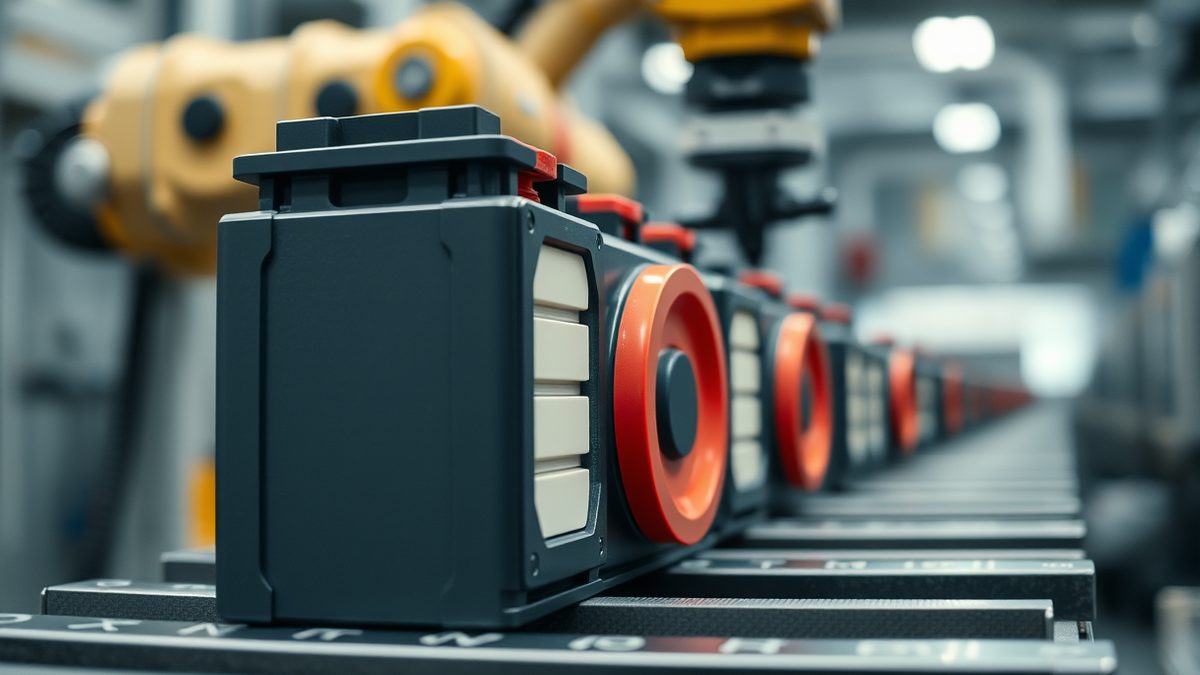
General Motors said on 29 September that its Ultium Cells joint venture with LG Energy Solution will upgrade the Spring Hill, Tennessee plant to produce LMR (lithium manganese-rich) battery cells, with the automaker taking the output for its forthcoming EVs. The announcement, reported by CleanTechnica, is the most concrete sign yet that GM expects the US electric vehicle market to recover after a bruising two years.
It is also a bet on chemistry rather than volume. GM's LFP and LMR investments will add up to a combined $2 billion by 2030, the company says. The plant will produce high-nickel, LFP and LMR cells in both pouch and prismatic formats.
"By producing multiple chemistries, including high-nickel, lithium iron phosphate (LFP), and now LMR, in both pouch and prismatic form factors, Ultium Cells demonstrates its ability to adapt quickly as battery technologies evolve to meet a broad range of applications, from electric vehicles to energy storage," GM said, according to CleanTechnica's 29 September report.
The timing matters because the US numbers are not good. CleanTechnica, writing on 30 September, put the US battery-electric share at 5.9% in the first half of 2026. That compares with 45% in China in August and 26% in Europe in July, both figures cited by the same outlet. Uruguay has reached 50%, according to a report by Juan Diego Celemín Mojica that CleanTechnica referenced.
Cheaper cells, fewer jobs than the old plan
LMR sits in the affordable slot. GM's vice president of battery and sustainability, Kurt Kelty, says the company's high-nickel batteries continue to serve markets where long range is the priority, while LMR comes in when affordability is the primary goal. GM expects the new formula to deliver improved performance at a lower cost than other batteries in the affordability category.
Manganese is earth-abundant and cheaper than other battery materials, which is why Ford and others have spent research money trying to make it behave in a cell. The chemistry has known problems: short lifespan and voltage decay, according to CleanTechnica. GM is not the only company working on it, and the fact that it is going into a production plant rather than a lab is the news.
Motor Illustrated reported on 29 September that the plan adds 500 jobs in Tennessee. That is a modest number for a battery plant announcement, and it lands in a state that has become a hub for the industry.
The federal backdrop is hostile. CleanTechnica's 29 September piece notes that EV sales in the US nosedived after Congress eliminated the $7,500 federal EV tax credit, and that GM was among the automakers that pulled back on EV lineups last year. The same piece says GM pivoted into stationary energy storage using LFP cells while keeping LMR on the back burner through Ultium Cells.
That pivot is visible elsewhere in the dossier. WardsAuto reported on 29 September that GM is now using recycled battery materials for its new EVs. Hyundai and LG Energy Solution announced a second-life scheme for used EV batteries, according to a 29 September report by batteriesnews.com, and Samsar Upcycled an EV battery from its 1,000th Nissan Leaf, batteriesnews.com reported the same day.
The supply chain is still elsewhere
The US push to build cells at home runs into a materials problem. The BBC reported on 29 September that China leads the world in sodium-ion battery manufacturing, and that lithium-ion is even more concentrated: China dominates the materials supply chain as well as manufacturing. San Diego-based Unigrid, which sells a nine kilowatt hour sodium-ion home battery, currently uses cells made in China, its co-founder and chief executive Darren Tan told the BBC.
"We have requests coming from Spain, France, Germany, The Netherlands," Tan said, according to the BBC. "We've shipped the first 100 units and [expect to ship] 1,000 before the end of the year."
Unigrid's cathode contains chromium-3. Professor Dame Clare Grey at the University of Cambridge, co-founder of battery firm Nyobolt, told the BBC that under certain conditions chromium-3 may form chromium-6, a toxic, cancer-causing material. Ivana Hasa of the Warwick Manufacturing Group, who has no connection to Unigrid, agreed that chromium-6 can form at very high states of charge but said it can be mitigated by voltage control, and described safety tests on the cell chemistry as "very promising." Tan told the BBC that concerns are "overblown" and that third-party tests have not produced chromium-6.
Older lithium-ion supply chains are also under strain. Stellantis plans temporary halts at French factories over a battery shortage, Automotive News reported on 29 September. VW Group is deepening ties with Gotion in a push for cheaper EV batteries, according to Automotive News. European battery groups are lobbying to keep post-Brexit UK-EU tariff rules for EVs from 2027, the Financial Times reported on 30 September.
China is not standing still. China has set a 2030 target for initial mass production of solid-state batteries, according to finance.biggo.com, and BYD plans its first solid-state battery car for 2027, reported by Tech Edition and InsideEVs. Mercedes-Benz has tapped ProLogium's Gen4 solid-state battery for a next EV push, CarbonCredits.com reported on 29 September. LG Energy Solution and GM are described by Chosun Ilbo as preparing to mass-produce the world's first LMR prismatic batteries.
The demand signal from raw materials is ugly. Lithium prices in China plunged 25% on fears over battery demand growth, The Straits Times reported on 30 September.
Trucks, tariffs and the rest of the world
Toyota, meanwhile, is marketing durability rather than range. On 30 September, Electrek reported that Toyota dropped a 1,675 lb (760 kg) caravan 30 feet onto the roof of its electric Hilux at Bentwaters airfield in Suffolk, and the pickup drove off. The Hilux BEV has a 59.2 kWh water-cooled lithium-ion battery, a WLTP range of up to 160 miles (257 km), 236 miles (380 km) on the city cycle, and DC fast charging at up to 125 kW from 10% to 80% in about 30 minutes. It is Toyota's first electric pickup and its first body-on-frame EV, with a dual-motor all-wheel-drive setup producing 278 hp (208 kW) and 348 lb-ft (473 Nm).
In the UK, the base Hilux BEV Icon is available to order from £42,170 ($56,500), not including VAT, Electrek reported.
The geographic spread of electrification is the context for GM's bet. Australia now has EVs at one in four new car sales, according to CommBank. India has notified CAFE III fuel efficiency norms giving three times the credit for battery EVs, The Economic Times reported on 30 September. Morocco is getting a Gotion High-Tech and PowerCo joint venture in the battery sector, Italpress reported. South Africa's most industrialised economy is set to host a battery-material facility in a $3.7bn European EV supply chain, Business Insider Africa reported on 29 September.
None of that changes the arithmetic in Tennessee. GM is spending against a market that shrank after the tax credit ended, betting that cheaper LMR cells will bring buyers back when the lineup arrives. The Spring Hill upgrade is the first hard commitment. Whether the cells are cheap enough, and whether US buyers return, is the part that is not in the filing yet.
Sources
4- 01GM Really Wasn't Kidding About Those New LMR EV BatteriesEN
- 02Is The US Going To End DEAD LAST In Vehicle Electrification?EN
- 03Toyota dropped a 1,675 lb caravan on its electric truck, and it drove off unfazed [Video]EN
- 04The start-ups hoping to return battery making to the USEN
All figures and quotations in this text come from the sources listed below.
Content prepared by the editorial team with AI assistance.
Daniel Fisher
Comments
0- No comments yet — be the first.