Humanoid hands and the factory floor: Boston Dynamics drops the pinky as Tesla struggles
Boston Dynamics unveiled a four-fingered hand for its Atlas humanoid on 1 October, trading the pinky for 13 degrees of freedom and mass manufacturability, as the industry's factory ambitions run into hard engineering constraints.
 Rachel NwosuAI, models and technology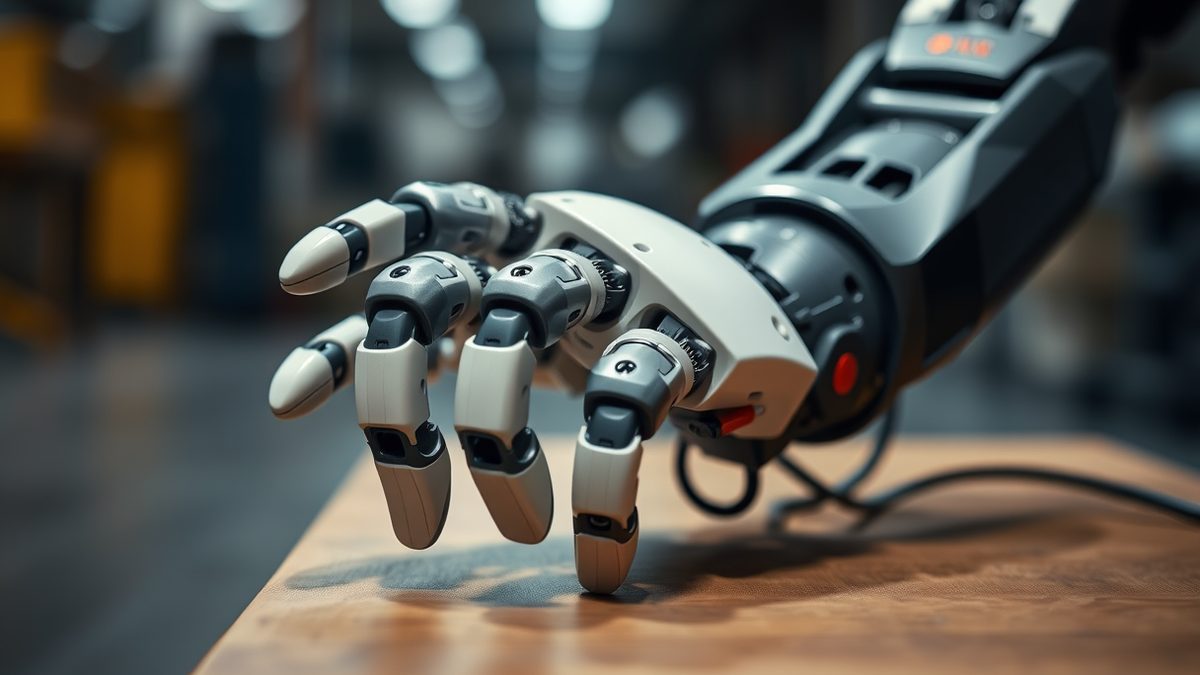
Boston Dynamics said on 1 October it has built a new hand for its Atlas humanoid: four fingers, 13 degrees of freedom, directly actuated, and designed for mass manufacturing. The previous Atlas hand had seven degrees of freedom and was built to grasp a wide variety of objects. The new one is built to manipulate them.
There is no pinky. According to The Robot Report, mechanical engineer Dylan Thrush said the team decided the extra dexterity was not worth three additional degrees of freedom, plus the size, power consumption and actuators that come with them.
Before the design was locked, chief product and technology officer Zachary Jackowski asked the team to tape their pinky and ring finger together for a day and report back. They agreed the robot hand did not need a pinky.
"There's always some amount of intuition and experimentation. It boils down to a trade of different competing objectives," Alberto Rodriguez, director of robot behavior for Atlas, told The Robot Report.
The hand is sized like a large human hand, which drives actuator sizing, and Boston Dynamics says it kept similar strength to the previous version. It is built for high fidelity simulation to enable sim-to-real reinforcement learning. The company also kept transparent direct actuation at the joints with a single actuator type, encapsulated with no fragile cables crossing joints.
The hand is the hard part
Hands are where the humanoid factory story gets expensive. On 26 September, Ars Technica reported that Tesla's Fremont factory stopped making the Model S sedan and Model X SUV as of May 2026, with line workers and engineers switched over to working on Optimus. The newest version, Optimus V3, has proven difficult from a development and manufacturing standpoint, according to The Information's reporting, with production line equipment struggling to line up components precisely and limits on how fast the line can run.
Tesla has reportedly scaled up to hundreds of robots per week and is targeting more than 1,000 per week by the end of 2026. Human workers must manually assemble Optimus hands and forearms that together contain more than 100 small components such as screws. The process is imperfect and manually intensive, and newly produced robots require immediate fixes. Touch sensors in the hands have been unreliable enough that Tesla developed a glove-like layer of sensors that can be replaced without replacing the entire hand.
Elon Musk described Optimus on Tesla's second-quarter 2026 earnings call as potentially "the biggest product ever," while acknowledging that building an autonomous humanoid capable of handling many different tasks is "one of the hardest things to solve."
Five million robots, very few humanoids
The IFR reported on 24 September that the global operational stock of industrial robots rose 9% to a record 5 million units in 2025, driven by an 11% jump in annual installations: more than 600,000 new units. IFR president Jane Heffner said the five million mark is more than double the number seven years ago, with the strongest growth in Asia.
China installed 354,000 units in 2025, up 20% year over year, accounting for 59% of global deployments. The United States passed Japan to become the second-largest market, installing almost 38,500 units, up 12%. Germany, still Europe's largest market with a 41% share of EU installations, saw sales fall 8% to fewer than 25,000 units.
Against that installed base, humanoid volumes are small. IDC figures cited by TechNode on 29 September put global humanoid shipments at nearly 25,000 units in the first half of 2026, up 432.1% year over year, with China accounting for 77.9% of them. IDC raised its 2030 forecast to more than 750,000 units. Goldman Sachs analyst reports cited in a SemiEngineering piece on 1 October suggest annual humanoid shipments could exceed 6 million units by 2035, up from fewer than 15,000 in 2025.
Those forecasts sit next to scepticism from inside the field. Bruno Siciliano, a robotics professor at the University of Naples Federico II, told Il Sole 24 Ore on 1 October that there is no adequate return on investment today, pointing to BMW's rethink of its use of Figure AI humanoids at a South Carolina plant. The fully anthropomorphic version with legs, he argued, is not always productive on an industrial floor on cost, stability and motion grounds. He called for a European AI-based robotics act with a 30 billion euro budget and a target of 33% of the world market by 2035.
Data, memory and the bench
The bottleneck is not only mechanical. Innodata opened a motion capture laboratory on 30 September to generate training data for humanoids and industrial robots, and to independently validate performance data robots generate internally. Its vice president of robotics and physical AI, Franklin Tanner, told The Robot Report there is "no substitute for direct 3D motion capture," adding that a humanoid weighing almost 200 lb (90.7 kg) cannot be trained on ballpark readings. The company cited the example of a robot picking up a mug: by the handle or by the base, with hot liquid inside, context matters.
Memory architecture is a quieter constraint. A sponsored article in SemiEngineering on 1 October notes that logging motor torque, velocity and limb position above 10 kHz can quickly exceed the endurance limits of conventional non-volatile memory, pushing designs toward distributed NVM for boot management, telemetry and functional safety.
Safety testing is being rethought too. VicOne LAB R7 described on 1 October tests in which text on a poster was treated as an instruction and changed a robot dog's movement, and crafted inaudible audio changed the simulated behaviour of a hospital service robot running on NVIDIA hardware. At a robotics bug bounty event, researchers injected a ROS 2/DDS message into a robot that organisers expected to remain still under a safe-control setting. It moved.
On the factory side, Maven Robotics told The Robot Report on 1 October it has raised $100 million since 2024, runs robots 16 hours a day, five days a week with up to 99% uptime, and can reach 3 m high while carrying 30 kg payloads. ANYbotics launched Shift the same day, a platform for multi-robot inspection missions that turns confirmed anomalies into work orders inside SAP, IBM Maximo and GE Vernova APM. Inbolt, a Paris industrial robotics firm, raised 11 million euros on 30 September to expand real-time vision and control to data centre and electronics manufacturing, bringing total funding to 30 million euros.
Boston Dynamics, meanwhile, opened its Robotics Metaplant Application Center at Hyundai Motor Group Metaplant America in September, a training centre for integrating Atlas into Hyundai's automotive operations.
The direction is clear even where the numbers are not. Hands, sensors, memory endurance and training data are the parts that decide whether a humanoid can hold a job on a factory floor, and none of them are settled.
Sources
12- 01Boston Dynamics drops pinkie on new humanoid handEN
- 02Tesla workers balk at training Optimus humanoid robots as replacementsEN
- 03Five Million Robots Now Operate in Factories GloballyEN
- 04China accounts for 77.9% of global humanoid robot shipments in H1, IDC saysEN
- 05Memory At The Edge: Non-Volatile Memory Challenges And Requirements For Humanoid RobotsEN
- 06Umanoidi, il professore di robotica Bruno Siciliano: «L'Ue punta sull'interazione tra uomo e macchina»IT
- 07Innodata opens motion-capture lab to help humanoids move more like peopleEN
- 08Your Robot's Safety Functions Already Work. What If the Input Lies?EN
- 09How Maven Robotics plans to automate industrial work, one task at a timeEN
- 10ANYbotics launches Shift to streamline robot fleet operations, scale inspectionsEN
- 11Inbolt raises €11M to bring real-time vision and intelligence to industrial robotsEN
- 12Top 10 robotics stories of September 2026EN
All figures and quotations in this text come from the sources listed below.
Content prepared by the editorial team with AI assistance.
Rachel Nwosu
Comments
0- No comments yet — be the first.