Boston Dynamics' four-fingered Atlas hand and the factory robots already working
Boston Dynamics unveiled a new four-fingered hand for its Atlas humanoid on Thursday, dropping the pinky and cutting degrees of freedom from seven to 13 as the company pushes Atlas into Hyundai's Georgia auto plants.
 Grace OkonkwoAI, models and technology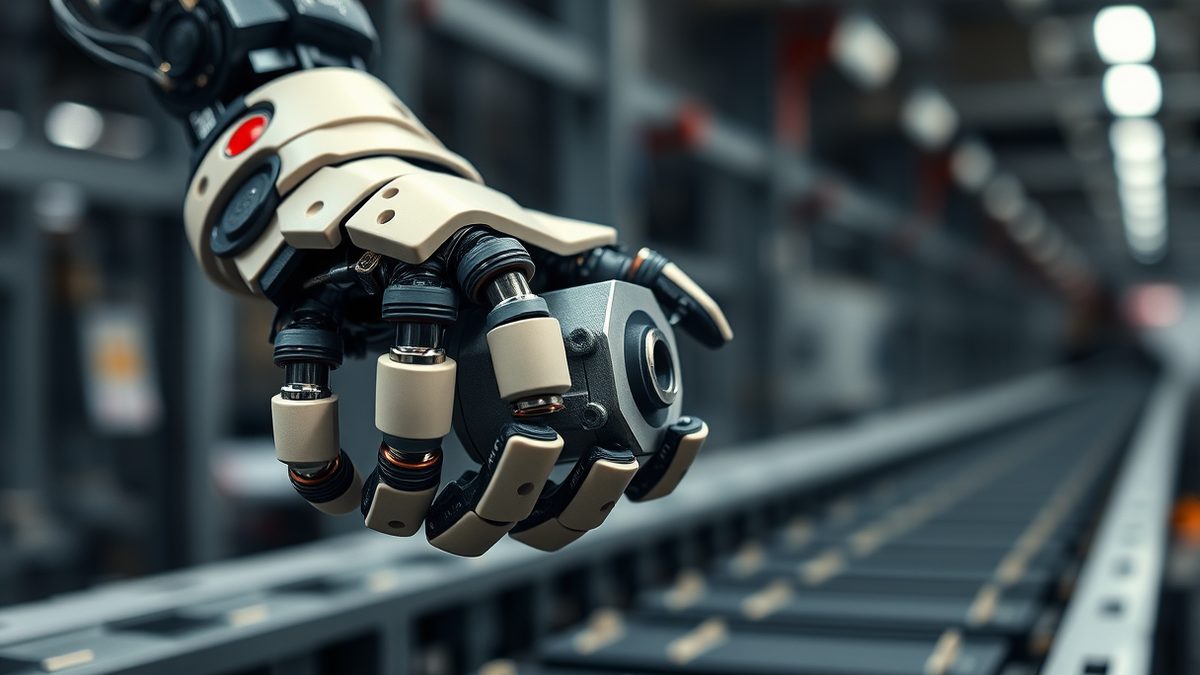
Boston Dynamics unveiled the newest hand for its Atlas humanoid on Thursday. The hand has four fingers and 13 degrees of freedom, is directly actuated, and is designed for mass manufacturing, according to The Robot Report.
Previous versions of the hand had seven degrees of freedom and were built to grasp a wide range of objects. The new one shifts the emphasis from grasping to manipulating things: in-hand reorientation, recovery from a slipping grasp, and handling tools while pressing their triggers.
"There's no pinky because the team determined that the additional dexterity and tasks you'd be able to accomplish is not worth the extra complexity of three additional degrees of freedom, the size, the power consumption, all of the things that come with adding additional actuators," said Dylan Thrush, a mechanical engineer on the Atlas team, in the company's announcement.
Why the hand matters more than the legs
The hand news landed one week after Boston Dynamics opened its Robotics Metaplant Application Center at Hyundai Motor Group Metaplant America in Georgia, a training center for integrating Atlas into Hyundai's automotive manufacturing operations. The Robot Report put that opening in its September top 10 list, and the facility is the clearest sign yet that the company's commercial bet is on repetitive industrial work rather than demonstrations.
Hands are where that bet gets tested. Tesla's experience is instructive. Ars Technica reported on 26 September, citing extensive reporting by The Information, that human workers must manually assemble Optimus hands and forearms that together contain more than 100 small components such as screws. Touch sensors for the hands have proven unreliable enough that Tesla developed a glove-like sensor layer that can be replaced without replacing the whole hand.
The same report said Tesla's Fremont factory stopped making the Model S and Model X in May 2026, moving line workers and engineers onto Optimus. Production has reportedly scaled to hundreds of robots per week, against a target of more than 1,000 per week by the end of 2026. Ars Technica also reported that Tesla has asked factory workers in Texas and California to wear suits that record their physical movements, and that some employees have pushed back against training their own replacements. One of The Information's sources described the robots as currently requiring programming for specific tasks in carefully controlled environments.
The sensor problem nobody demos
Force and torque sensing is the unglamorous layer under all of this. Vishay Precision Group said it will present custom force and torque sensors at RoboBusiness 2026, and its argument is that off-the-shelf parts fail as designs mature: stock sensors are often too large for small robot limbs, their measurement ranges are too broad, they lack multi-axis measurement, and they need bulky external electronics.
"At VPG, we focus on providing precision sensing solutions exactly where they are needed most: at the key points of performance, safety, and control in advanced intelligent systems," said Ron Zukerman, Innovation Director at Vishay Precision Group.
ForceN, which supplies force torque sensors for robotic wrists, will run a session at the same event on 20 and 21 October in Santa Clara, California. Robert Brooks, the company's founder and CEO, will summarise what he has learned working with humanoid companies over the past three years, according to The Robot Report.
Safety researchers are probing a related weakness. VicOne LAB R7 described tests in which text on a poster was treated as an instruction by a robot dog running Gemma 4 E4B and changed its movement, and where crafted audio inaudible to people changed the simulated behaviour of a hospital service robot. At a robotics bug bounty event, researchers injected a ROS 2/DDS message into a robot that organisers expected to remain still under a safe-control setting. The robot moved.
Five million robots, few of them humanoids
The gap between the humanoid conversation and factory floors is measurable. The International Federation of Robotics said on 24 September that the global operational stock of industrial robots rose 9% to a record 5 million units in 2025, driven by an 11% jump in annual installations to more than 600,000 new units. China accounted for 59% of deployments, with 354,000 installations, up 20% year on year, and domestic manufacturers took a 55% share of their home market.
The United States passed Japan to become the second largest market, installing almost 38,500 units, up 12%. Germany, the largest European market with a 41% share of EU installations, saw sales fall 8% to fewer than 25,000 units. Humanoids barely register against those numbers.
China's share of humanoid shipments is a different story. TechNode reported on 29 September, citing figures attributed to IDC, that China shipped more than 19,000 humanoid robots in the first half of 2026, or 77.9% of global shipments. Global shipments reached nearly 25,000 units, up 432.1% year on year, and IDC raised its 2030 forecast to more than 750,000 units.
Not every company is chasing the humanoid form factor. Maven Robotics, founded in 2024, has raised $100 million and reached a production contract with its first customer; CEO Hamza Derbas told The Robot Report his robots run 16 hours a day, five days a week, with up to 99% uptime. "The humanoid robotics companies, the ones with legs, were starting with the human form factor and trying to work backwards into a problem to be solved," he said.
ANYbotics took the same route with quadrupeds. It launched ANYbotics Shift on Thursday, a platform for planning multi-robot inspection missions and turning field data into work orders. The Zurich company cited an estimate that undetected failures cost the world's 500 largest companies $1.4 trillion a year in downtime, with a single hour of outage averaging $250,000.
Training data and the price ceiling
Data, not hardware, is the recurring bottleneck. Innodata opened a motion-capture lab on 30 September to generate training data for humanoids and industrial robots, and will also validate performance data robots produce internally. "Physical AI has to earn its tokens one interaction at a time, and they have to be deliberate," Franklin Tanner, the company's vice president of robotics and physical AI, told The Robot Report.
At the consumer end, price decides everything. Flourish began selling Flourish One, a $3,555 wheeled humanoid-style home robot, with a first batch of 50 units hand-built and a target of shipping before Christmas. Each arm has a 1.5 kg payload, the battery is designed for 12 hours of arm operation, and the unit runs on a Raspberry Pi. It is not waterproof and will not do dishes.
European robotics professor Bruno Siciliano told Il Sole 24 Ore he does not think the goal should be a humanoid that breaks sprint records, arguing instead for a European model of physical AI built around human interaction. He pointed to BMW's rethink of its use of Figure AI humanoids in South Carolina as evidence that the fully anthropomorphic version, legs included, is not always productive in a plant, citing cost, stability, movement agility and regulation. He also said no European jurisdiction will accept robot economic autonomy in contract law, a point The Robot Report covered in its look at crypto wallets for machines.
Two recent data points show the financial risk on the humanoid side. Unitree Robotics shares fell nearly 40% in September 2026 from their first-day closing price on 19 August, erasing roughly $20 billion in market value from that point, according to The Robot Report's September roundup. And Figure retired its F.02 fleet by having the robots jump into a 75-tonne electric arc furnace in Imatra, Finland, a stunt heise reported on 1 October that also served to destroy protected components so nobody could reuse them. The company said keeping the old robots running would have cost too much time, which it preferred to spend on the next generation.
Inbolt raised €11 million on 30 September to bring real-time 3D vision to industrial robots, with customers including Bosch, Beko, Flex, Ford, Stellantis and Toyota, and more than 200 robots deployed across 100 factories. Its pitch is blunt: robots have run blind for fifty years, and the fix is software, not hardware.
Sources
15- 01Boston Dynamics drops pinkie on new humanoid handEN
- 02Top 10 robotics stories of September 2026EN
- 03Tesla workers balk at training Optimus humanoid robots as replacementsEN
- 04Vishay Precision Group to showcase custom sensing capabilities for humanoid robotics at RoboBusiness 2026EN
- 05ForceN to give a crash course on force and torque sensing for humanoids at RoboBusinessEN
- 06Your robot's safety functions already work. What if the input lies?EN
- 07Five million robots now operate in factories globallyEN
- 08China accounts for 77.9% of global humanoid robot shipments in H1, IDC saysEN
- 09How Maven Robotics plans to automate industrial work, one task at a timeEN
- 10ANYbotics launches Shift to streamline robot fleet operations, scale inspectionsEN
- 11Innodata opens motion-capture lab to help humanoids move more like peopleEN
- 12Meet Flourish One, the Raspberry Pi-powered humanoid built for busy parentsEN
- 13Umanoidi, il professore di robotica Bruno Siciliano: l'Ue punta sull'interazione tra uomo e macchinaIT
- 14Figure mustert humanoide F.02-Roboter aus und lässt sie in Schmelzofen springenDE
- 15Inbolt raises €11M to bring real-time vision and intelligence to industrial robotsEN
All figures and quotations in this text come from the sources listed below.
Content prepared by the editorial team with AI assistance.
Grace Okonkwo
Comments
0- No comments yet — be the first.