Humanoid Robot Factories Are Scaling Up, but the Hard Part Is Still the Hands
Industrial robots passed a record 5 million operational units worldwide in 2025, the International Federation of Robotics reported on 24 September, as humanoid developers race to turn pilot lines into real factories. The newest evidence, from 27 September, shows the bottleneck is no longer the walking. It is the hands, the data and the maintenance.
 Rachel NwosuAI, models and technology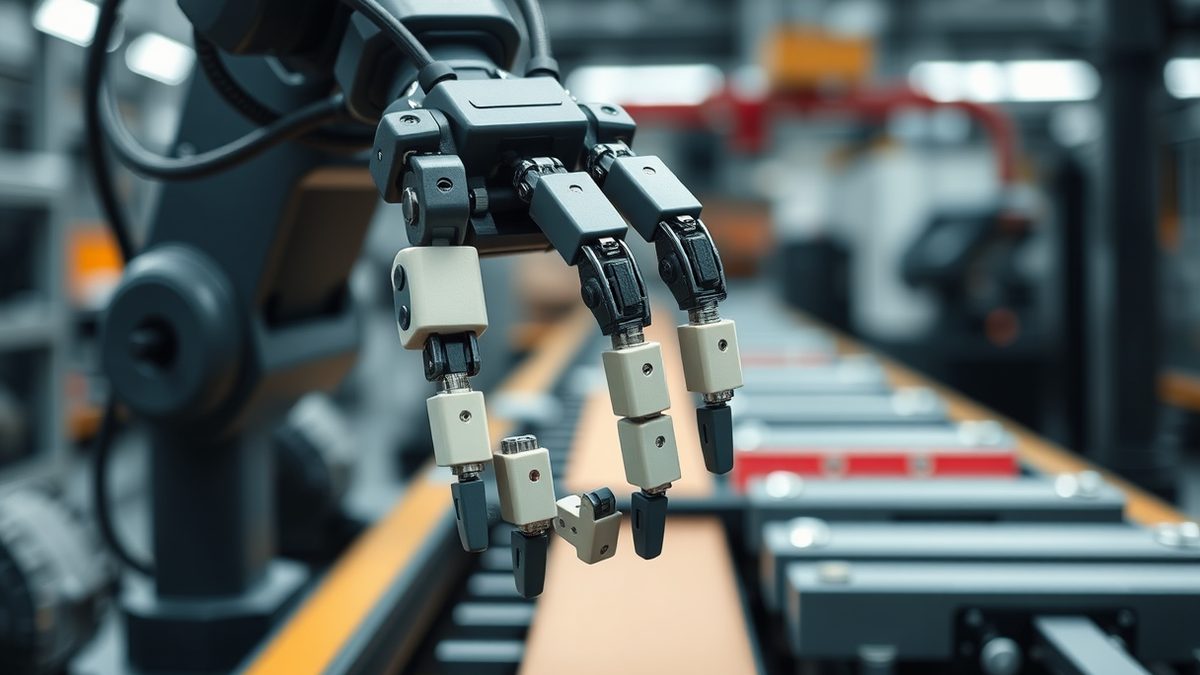
The number that landed on 24 September is not about humanoids at all, and that is exactly why it matters. The International Federation of Robotics said the global stock of industrial robots rose 9% to a record 5 million units in 2025, with more than 600,000 new installations, an 11% jump. China alone accounted for 59% of deployments, installing 354,000 units, up 20% year on year.
“Industrial automation is progressing at high speed,” IFR president Jane Heffner said in the release. The Federation expects installations to reach 655,000 units in 2026 and 806,000 by 2029. The Robot Report carried the same figures on 24 September.
Humanoids are a rounding error next to that base. That is the point: the factory is already robot territory, and the humanoid crowd is trying to move in.
The hands are the problem
On 27 September, The Decoder reported that researchers at Stanford and Caltech built a system called HomeBody, which runs a Unitree G1 robot in an unfamiliar kitchen. The setup drops the usual trained control layer between the language model and the hardware. A swappable vision-language model, in this case OpenAI's GPT-6 Astra, calls directly into a library of skills for grasping, navigating and opening drawers. The robot maps the room, builds a digital twin in Nvidia's Isaac Sim and keeps spatial memory so it can find objects that leave its field of view.
The reported limitations are the interesting part: latency, overheating finger servos, and high compute costs. That is a research demo in a kitchen, not a factory shift. But it names the same constraint the big buyers keep running into.
Ars Technica reported on 26 September that Tesla's Optimus V3 programme is struggling with production line alignment and speed, citing extensive reporting by The Information. Workers must manually assemble hands and forearms that together contain more than 100 small components, including screws. Newly built robots need immediate fixes, and unreliable touch sensors forced Tesla to develop a glove-like sensor layer that can be replaced without swapping the whole hand.
One of The Information's sources described Tesla's Optimus robots as currently requiring programming to do specific tasks in carefully controlled environments.
Tesla has reportedly scaled to hundreds of robots per week and is targeting more than 1,000 per week by the end of 2026. Ars Technica also noted that workers in Texas and California were asked to wear motion-capture suits to generate training data, and that some complained because they knew the robots were designed to replace them. Tesla has since moved that data collection to dedicated teams and training hubs, according to the report.
Toyota's order of magnitude
Toyota is planning a far bigger number, on a longer clock. Ars Technica reported on 23 September that the Toyota Motor group aims to start investing $6.42 billion every year from 2028 in factory robots, citing Nikkei Asia. The plan is 150,000 robots in its own automotive plants and another 250,000 at group facilities making components and materials.
Toyota has already put ELEY humanoid robots on assembly lines to learn from workers, who teach them precise hand movements by wearing jigs based on the robots' fingers. Executive vice president Hiroki Nakajima told Nikkei Asia the company wants “a world where robots coexist with humans, rather than replacing them.”
Those two claims sit awkwardly together, and nobody has resolved how many of the 400,000 units will be humanoids at all. Hyundai has its own plan: up to 25,000 Boston Dynamics Atlas robots in Hyundai and Kia plants over the next several years, with deployment starting in 2028. Boston Dynamics opened a training centre at Hyundai's Metaplant America in Georgia on 21 September.
Modularity and maintenance
If hands and downtime are the constraints, the pitch from smaller companies is repairability. Tech.eu reported on 24 September that O-ID, a Tokyo startup founded in 2025 by Norwegian CEO Stian Jakobsen and Dutch CTO Simon Gormuzov, raised $1.2 million in pre-seed funding led by Chicago-based TAWANI Ventures. O-ID is building modular humanoids for manufacturing and logistics, with factory pilots planned for 2027 and onboard sensors that flag parts approaching failure before a robot goes down.
That is a $1.2 million bet against a problem that, by Tech.eu's own framing, can cost a large automotive plant $2.3 million an hour of downtime. It is not a fight O-ID can win on capital. It is a claim that architecture beats scale on maintenance.
The Robot Report, meanwhile, reported on 25 September that Agility Robotics is exploring wheeled robots, a notable admission for a company built on legs. CEO Jonathan Hurst said Agility is “exploring a range of robot designs and form factors, including wheels,” and called it “too early to say” whether that means a wheeled Digit or a new machine. Agility is going public through a SPAC with Churchill Capital Corp. XI at a $2.5 billion valuation, on $1.8 million of 2025 revenue and a $140 million operating loss.
Add it up and the factory story of late September 2026 is not a robot walking through a door. It is a supply chain being asked to make hands, sensors and service depots at volumes nobody has hit yet, while the IFR's 5 million installed industrial robots keep working the lines the humanoids are supposed to join.
Sources
7- 01Five Million Robots Now Operate in Factories GloballyEN
- 025 million robots are now at work in factories worldwide, reports the IFREN
- 03Researchers plug GPT-6 Astra directly into a robot and let it clean up an unfamiliar kitchenEN
- 04Tesla workers balk at training Optimus humanoid robots as replacementsEN
- 05Toyota orders workers to train humanoid robots but says humans won't be replacedEN
- 06Europeans in Japan raise $1.2M to put modular humanoid robots to workEN
- 07Agility Robotics, maker of Digit humanoid, exploring wheeled robotsEN
All figures and quotations in this text come from the sources listed below.
Content prepared by the editorial team with AI assistance.
Rachel Nwosu
Comments
0- No comments yet — be the first.