Humanoid robots: China gets the factories ready and hands out the first diplomas
Changan wants to mass-produce humanoid robots by 2028 and to build a robot that builds robots. In Hangzhou, the robot school has handed out its first diplomas after practical trade tests.
 Rachel NwosuAI, models and technology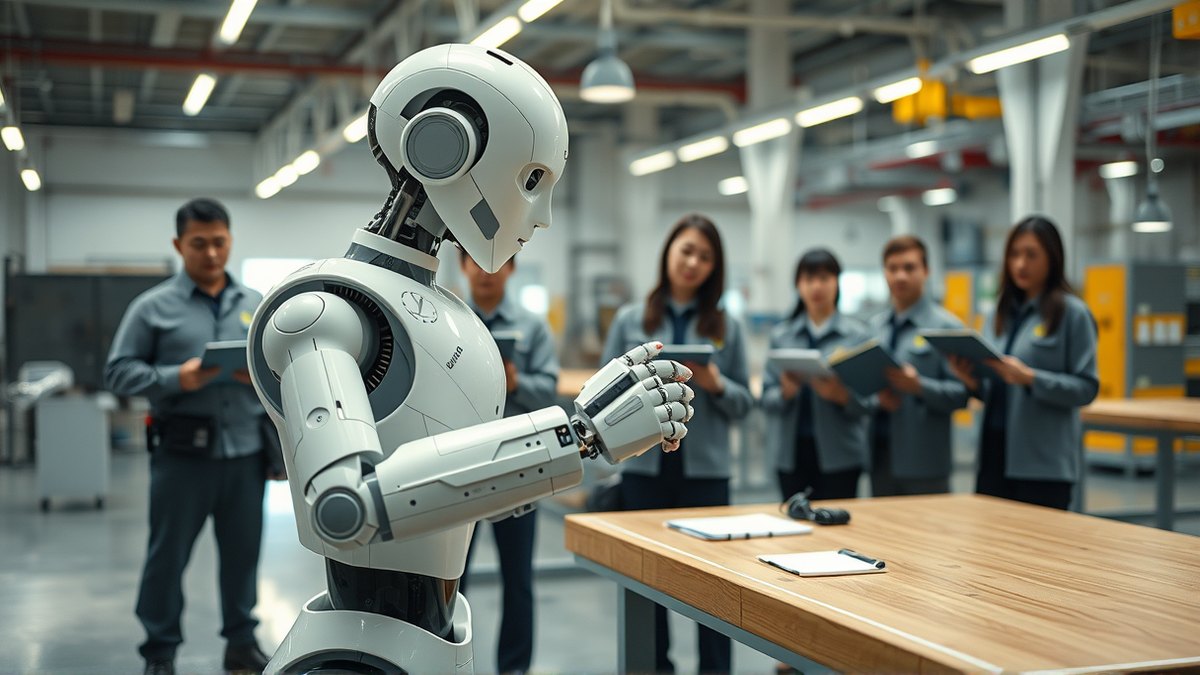
China treats humanoid robots as an industrial product to put on the line, not as a technology showcase. The clearest signal comes from the car group Changan. The company has set two goals: mass production of humanoid robots by 2028, and commercialisation of flying cars by 2030.
The strategy in stages
Changan's path is gradual, and it starts inside the cabin. The robots are first broken down into components inside the cars. From there they move into logistics, cleaning, energy storage, charging, inspection, security and firefighting. Executives sum up the formula in one line: build cars with robots, sell cars with robots, put robots inside cars. The stated goal is a factory where robots produce other robots. In the meantime, the company is validating a 20 Ah solid-state cell based on oxygen and polymers.
The problem of millimetres
Wang Xingxing, founder of Unitree, has pinpointed the technical knot. The bottleneck of embodied AI, he says, lies in the error of a few millimetres between what the model decides and what the robot does in the physical world. In his analysis, a ChatGPT moment for robotics will arrive when a machine can complete 80% of tasks in 80% of new scenarios. Today, efficiency and capability remain insufficient both for the factory and for the home. The way out lies in building more general models, able to transfer skills from one task to another.
Learning a trade
In Hangzhou the transition already has an organised form. The robot school has handed out its first diplomas, and there machines learn professional tasks through practical tests. The school collects training data in real contexts, and at the same time prepares the skills of the people who will have to manage fleets of machines.
What changes for manufacturing
For the European production system, and the Italian one in particular, the question is not replicating Chinese robots but integrating them. Flexible robotics becomes worthwhile when the cost per machine hour falls below that of the labour it replaces, and when reconfiguration times allow small batches, as specialised manufacturing requires. On this, the game is played more on software integration and on the operational safety of OT systems than on mechanics.
Sources
3- 01IT之家 — Changan: robot umanoidi in produzione di massa nel 2028ZH
- 02IT之家 — Unitree, Wang Xingxing: il collo di bottiglia è l'errore di pochi millimetriZH
- 03ANSA — Da automi a lavoratori: in Cina i primi diplomi della scuola dei robotIT
All figures and quotations in this text come from the sources listed below.
Content prepared by the editorial team with AI assistance.
Rachel Nwosu
Comments
0- No comments yet — be the first.