Hydro-Québec Hearing Puts a Price on Data Centre Power as Cooling Goes 800 VDC
Hydro-Québec asked the Régie de l'énergie on 1 October to approve a new electricity rate for data centres above five megawatts that would average 13 cents per kWh, roughly twice what they pay today.
 Grace OkonkwoAI, models and technology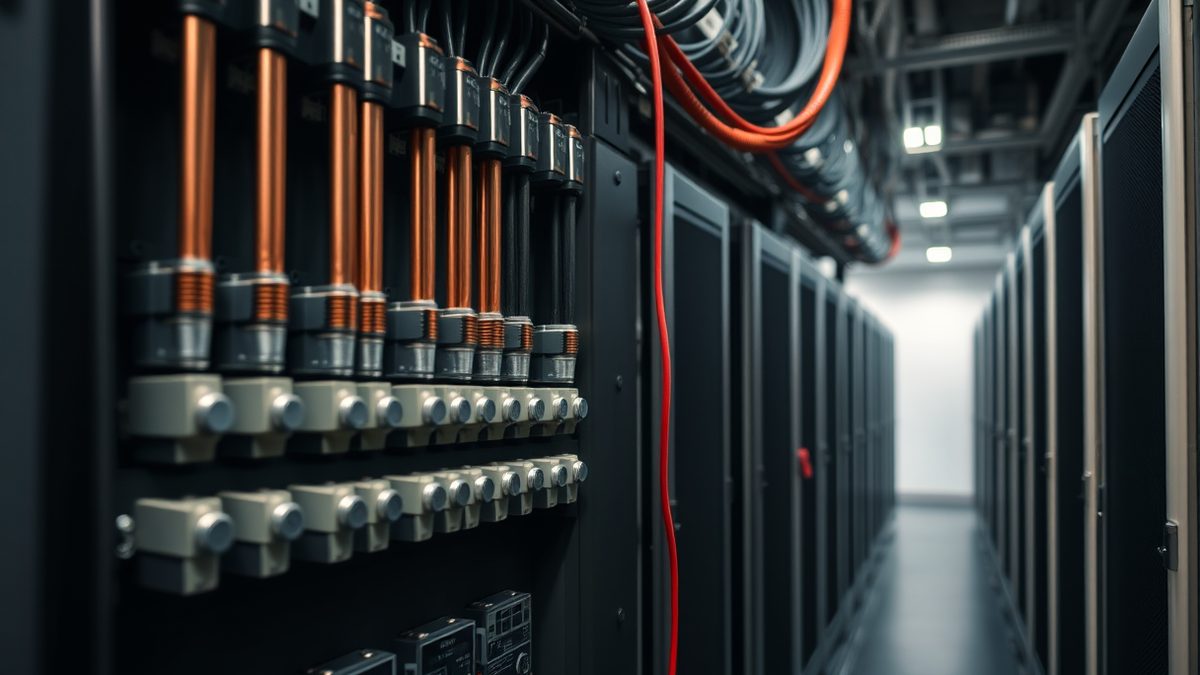
The hearing in Montreal opened on 1 October and runs until 9 October. It will pit the provincial utility against tech industry actors including Google, according to The Globe and Mail. Hydro-Québec says data centres under the proposed rate currently draw 190 MW at peak and could reach 1,000 MW by 2035.
Energy costs for Quebec data centres sit around six cents per kWh today, said energy analyst Jean-François Blain. "It creates an exceptional draw that benefits Quebec, as long as they can supply those companies," he said. The utility argues higher rates would limit how much of the sector's growing demand lands on residential bills.
Power procurement is now the project
The same day, Trane Technologies said it had demonstrated an 800-volt direct current chiller, built with Eaton and Danfoss, that delivered more than 1,000 tons (3.5 MW) of cooling capacity in the lab. Trane claims up to 2% better system efficiency than AC equivalents, which in a 200 MW data centre could free up to 1.8 MW for compute, enough for fifteen 120 kW racks, according to HPCwire.
That is one answer to a structural problem. Developers are increasingly evaluating behind-the-meter generation, microgrids, battery storage and expanded substations because high-voltage transmission lines, substations and large transformers can take years to develop or procure, writes Bill Tierney of ProLift Rigging in a sponsored piece for Data Center Dynamics. Power strategies get discussed in megawatts; construction teams get dimensions, weights, clearances and crane capacities.
"AI data centers are increasingly becoming power plants as well as computing facilities," Abhijit Sunil, senior analyst at Forrester, told Data Center Knowledge. "AI infrastructure can now be deployed faster than traditional permitting and inspection processes were designed to oversee."
Sunil's comment came in Data Center Knowledge coverage of a $1.07 million penalty that New Jersey's Department of Environmental Protection handed to a Vineland AI data centre operator. The state said the facility ran 62 natural gas generators without required permits; the operator, identified as DataOne, disputed the finding on the temporary generators but said it would apply for air permits, per the New Jersey Monitor.
The enforcement record is thin. On 22 September a state official announced the action, roughly six months after residents first raised concerns at a town hall, according to Ars Technica, which reported that thermal drone footage from The Guardian and Floodlight News showed 45 of the 62 generators running. DataOne has 45 days to apply for permits or cease operations, but can keep running the engines while it seeks them. Nichole Gardner of the local nonprofit Sustain SJ told Ars the penalty is "insufficient, both in dollar amount and enforcement."
Gas plans run into regulators
In Texas, administrative law judges at the Public Utilities Commission released a proposed decision on 30 September finding that El Paso Electric failed to adequately consider alternatives to a 366 MW gas plant and failed to issue a request for proposals, Inside Climate News reported. The plant would power Meta's $10 billion, 1 GW data centre in northeast El Paso. The judges recommended approval only if the utility does not pass capital and operating costs to ratepayers, and otherwise recommended denial. A hearing was held in July; the five commissioners have not scheduled a vote.
El Paso Electric initially claimed solar would supply the site, then applied in December to build 813 modular gas generators from Enchanted Rock at an estimated cost of $499 million. Meta would cover costs for the first five years, after which ratepayers could be asked to pay. The judges wrote that Wurldwide, a Meta subsidiary, drove the process.
In Missouri, Ameren filed a long-range energy plan on 28 September that adds 5,400 MW of gas by 2032, an increase of 1,700 MW, delays coal closures at Sioux and two Labadie units, and cuts pre-2030 solar investment by 900 MW, according to CleanTechnica. The utility dropped its carbon dioxide reduction goals from promotional materials for the plan.
Transmission is the other half of the equation. A bipartisan Senate permitting bill unveiled on 30 September would require regional grid operators and utilities to streamline planning and permitting and to use advanced transmission technologies. Analysis commissioned by the Center for Climate and Energy Solutions found the reforms could cut the cost of delivering electricity by roughly $7 billion by 2035 and reduce residential bills by about $1.1 billion, Canary Media reported.
Space, taxes and disclosure
Google's first Project Suncatcher test satellite launched on 1 October aboard a SpaceX Falcon 9, Ars Technica reported. The refrigerator-sized craft carries four TPUs and about one kilowatt of solar power; the cooling system can only run in roughly 15-minute bursts before the chips must shut down, Tom's Hardware noted. A separate Light Reading report had put the launch on 1 March, a discrepancy Google did not reconcile publicly.
Money is moving in the same direction as the hardware. Bain and Company estimates the AI industry must generate $6 trillion in annual revenue by 2031 to justify infrastructure spending that could reach $1.5 trillion a year, with data centre sizes and costs doubling roughly every 12 to 16 months, The National reported. Meanwhile Meta saved $3.9 billion in 2025 by classifying AI data centres as "pilot models" under a federal research tax credit, up from $2 billion the year before, according to The Decoder, citing the New York Times. Meta's SEC filings warn the savings could be challenged; its reserve for uncertain tax positions rose 45% to $18.74 billion.
Disclosure remains the weakest link. Lighthouse Reports filed a complaint against the European Commission on 28 September under the Aarhus Convention, accusing it of shielding data centre energy and water use from public scrutiny, POLITICO reported. Commission figures show European data centres used 20.7 TWh of electricity in 2025, up 26%, and more than 8 million cubic metres of water, up 52%, but the totals are incomplete and only published in aggregate.
In the Netherlands, less than a quarter of larger data centres publish electricity and water data, according to research by Lighthouse Reports with Trouw and other European media, NL Times reported. The Dutch enterprise agency RVO has data on only 104 of 186 commercial data centres above 500 kW. Statistics Netherlands puts 2024 Dutch data centre electricity use at 5.1 billion kWh, 4.6% of national consumption, and grid operator TenneT projects 10% to 15% by 2030.
Sources
15- 01Hydro-Québec asks regulator to hike energy rates for large data centresEN
- 02Trane Technologies Demonstrates 800-Volt Direct Current Chiller for Next-Gen AI Data CentersEN
- 03Sponsored: The data center is becoming a power projectEN
- 04Data Center On-Site Power Brings Pollution Risks Closer to HomeEN
- 05New Jersey fines data center $1.1M after drone pics expose 62 gas generatorsEN
- 06Texas Electric Utility Only Considered Gas to Power $10B Meta Data CenterEN
- 07Ameren Missouri Proposes Pollution-Heavy Future to Power Data CentersEN
- 08Senate permitting bill could greatly expand power lines and clean energyEN
- 09Google's first Suncatcher orbital data center test launches October 1EN
- 10Google's orbital AI data center test packs four TPUs and 1,000W of solar powerEN
- 11Google sets 'Suncatcher' AI orbital data center test launch for March 1EN
- 12AI needs $6tn in annual revenue to justify data centre boom, Bain saysEN
- 13Meta dodges billions in US taxes by calling its AI data centers experimentsEN
- 14EU accused of hiding environmental impact of data centersEN
- 15Most data centers refusing to say how much water, electricity they useEN
All figures and quotations in this text come from the sources listed below.
Content prepared by the editorial team with AI assistance.
Grace Okonkwo
Comments
0- No comments yet — be the first.