NASA reopens Hubble servicing question with industry request
NASA asked industry on 29 October for ideas on servicing the Hubble Space Telescope, including boosting its orbit, a rescue the agency declined in 2022. Space.com reported the request for information on 3 November.
 Dr. Amara PatelEconomy, business and world
A reversal from 2022
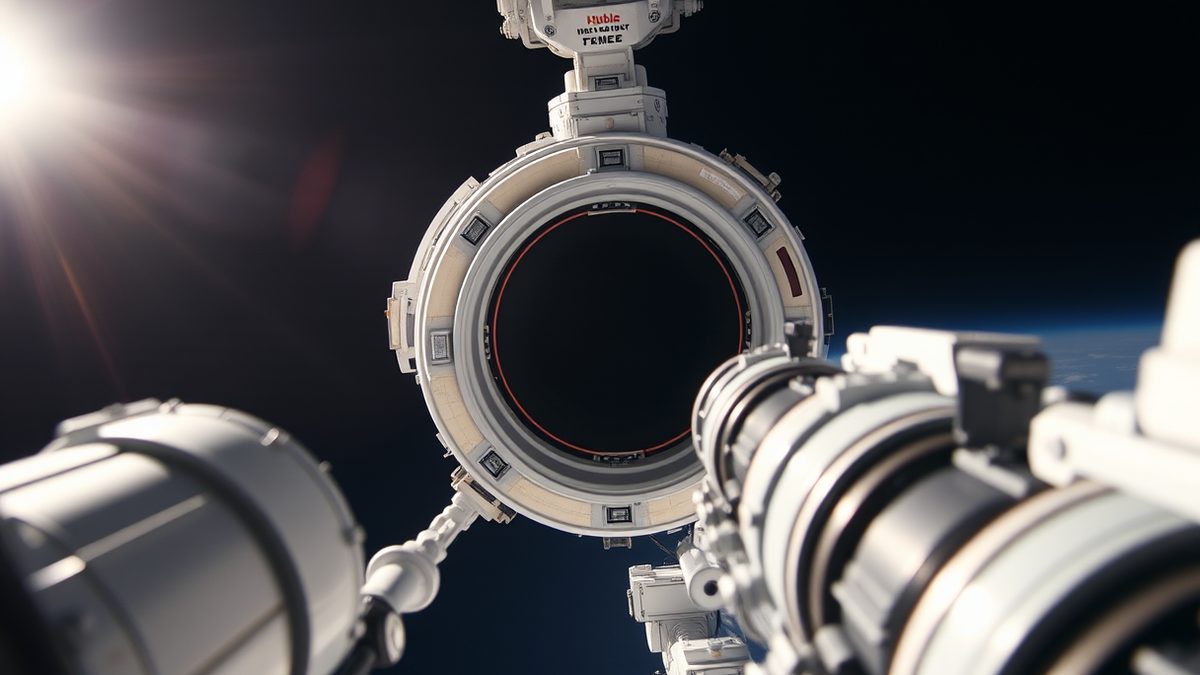
NASA issued the request for information on 29 October. It covers an orbit boost for Hubble or a mission to "enhance its capabilities" in some way.
In 2022, billionaire Jared Isaacman proposed using SpaceX hardware to mount a servicing mission. NASA declined, citing possible risks to a healthy observatory. Isaacman became NASA administrator in December 2025. In a 30 October statement, he said Hubble's science return meant NASA should "be looking at every reasonable opportunity to keep it delivering for as long as possible". A post on X the same day added that it is "still worth exploring the options".
Hubble should reenter Earth's atmosphere in 2033 or 2034 as drag pulls it down. NASA says any servicing attempt would have to fly in 2032. The agency is deciding now whether to pay for a rescue or let the telescope die. It is also deciding whether it buys servicing from a commercial operator rather than a replacement. There is no published cost estimate, funding source or decision date.
Hubble's clock
Hubble launched in April 1990. Shuttle astronauts serviced it five times, most recently in 2009.
Its observations have led to at least 23,000 scientific papers. NASA said in September that astronomers request about seven times as much observing time as is available each year.
Drag, not instrument failure, sets the deadline.
The Swift rescue shows the risk
Earlier this year NASA worked with Katalyst Space Technologies on a $30 million mission to boost the orbit of the Neil Gehrels Swift Observatory. Swift was also falling back to Earth because of drag. The mission launched successfully this summer. Control issues then stopped Katalyst's LINK spacecraft from meeting Swift. Swift should reenter on 4 November after 22 years of operations, against a two-year design lifetime.
The rehearsal failed at the rendezvous, not at the launch.
Hardware for hire
Commercial servicing is still young. Three former SpaceX engineers founded Argo Space in late 2022. The company builds spacecraft that use water as propellant, coolant and radiation shield, Ars Technica reported. Its Navigator demonstration flew in July on a Falcon 9 rideshare. One of two rollout solar arrays failed to deploy. The spacecraft stayed power-negative, and there was not enough energy left to test the propulsion system.
The debris side is moving faster.
ClearSpace UK built the UK Space Agency's first national mission. The mission will grab two defunct satellites and guide them back towards Earth to burn up. The agency says nearly 13,000 working satellites orbit Earth today, with around 60,000 possible by 2030. Its competition to name the mission closes on 10 December 2026.
Orbital Matter says its Replicator 2 satellite launched this summer. The satellite printed a half-meter beam in orbit, according to TechCrunch. Its engineers believe 100-meter booms are feasible. SpaceX's Starlink V2 satellites are among the most powerful mass-produced satellites in orbit. They use solar arrays 20 meters long.
What happens next
The request also allows for a "safe, controlled reentry into Earth's atmosphere or orbital disposal at the end of Hubble's mission".
Whether NASA treats servicing as a purchase or a one-off rescue is the question the industry now has to answer on paper. Hubble's science is not in doubt. Its budget line is.
Sources
28- 01NASA asks industry for ideas about saving Hubble Space TelescopeEN
- 02This space company is betting its future on a propellant available everywhereEN
- 03Name the UK Space Agency's Active Debris Removal MissionEN
- 04Orbital Matter 3D-printed the first rigid beam in the vacuum of spaceEN
- 05Simera Sense and Spacemanic to Collaborate on a New Complete Dual-Use Mission SolutionEN
- 06 Voting in space: NASA astronauts cast ballots from International Space Station EN
- 07 Do we know how many Starship launches SpaceX will need to get NASA astronauts to the moon? No. Will its refuelling plan be simple? Also no. EN
- 08 Dimorphos in sight: Europe's Hera probe gets its 1st look at battered space rock (photo) EN
- 09STAT+: Who will get the first psychedelic approved?EN
- 10 On this day in space! Nov. 3, 1957: Laika the dog launches with Sputnik 2 EN
- 11 Robot cube explores the International Space Station | Space photo of the day for Nov. 3, 2026 EN
- 12Churchill Capital XI shareholders approve $2.5B Agility Robotics humanoid SPACEN
- 13"At Home in Space" opens, caps Air and Space Museum renovationEN
- 14 On this day in space! Nov. 1, 1962: The Soviet Union Launches Mars 1 spacecraft to Red Planet during the Space Race EN
- 15Why Boost Mobile isn't SpaceX's shortcut to an MVNOEN
- 16 On this day in space! Nov. 2, 2000: Expedition 1 Arrives at the International Space Station EN
- 17Elon Musk: SpaceX will offenbar Mobilfunker Boost übernehmen – Deutsche Mobilfunk-Aktien geben nachEN
- 18 Google data center wins approval in Minnesota after protests delay council vote twice EN
- 19 SpaceX loses bid to dismiss lawsuit over xAI data center pollution EN
- 20 What is Starshield? A look at SpaceX's military satellite network EN
- 21 Rocket Lab launches Japanese Earth-observing satellite on 99th mission to date (video) EN
- 22 Planetary defense: How military and civil satellites are watching fireballs to help keep Earth safe from space rocks EN
- 23SpaceX No longer needs NASAEN
- 24 Astronauts deploy solar array on 100th US spacewalk by International Space Station crew members EN
- 25Launch Preview: Falcon 9 to launch USSF missions, China to launch internet satellitesEN
- 26 This Week In Space podcast: Episode 234 — Living in Lunar Caves EN
- 27French lawmakers approved a tax of €0.055 for every gigabyte of internet trafficEN
- 28 Halloween night sky 2026 — Saturn, shooting stars and a space station await US stargazers EN
All figures and quotations in this text come from the sources listed below.
Content prepared by the editorial team with AI assistance.
Dr. Amara Patel
Comments
0- No comments yet — be the first.