South Korea's chip exports pay for a record budget and complicate the rate call
President Lee Jae Myung unveiled a 2027 budget of 820.9 trillion won ($610.14bn) on Monday, a 12.8% increase built on a semiconductor export boom now running at its fastest pace since January 1974.
 Dr. Amara PatelEconomy, business and world
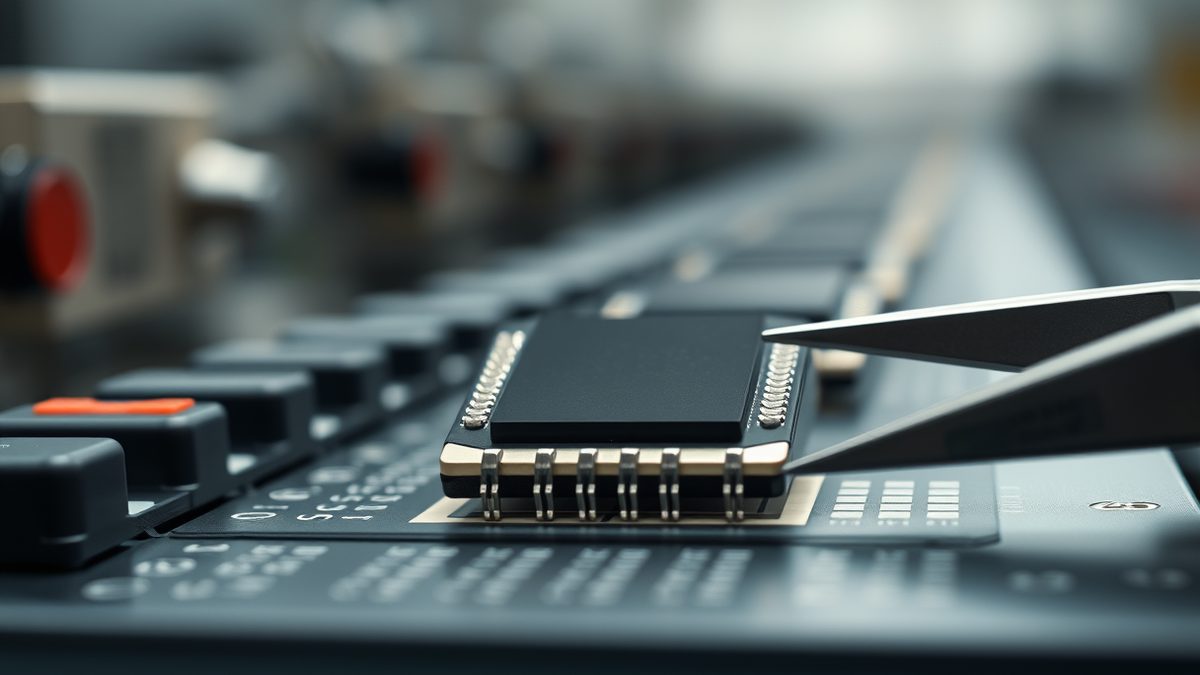
A record budget built on chip exports
Lee told the National Assembly on Monday that 2027 spending would rise 12.8% to 820.9 trillion won ($610.14bn). The plan includes 21.3 trillion won for semiconductors, physical AI and AI data centers. That is nearly double the 2026 level.
The split decides how much state money reaches chipmakers and AI infrastructure, three weeks before the Bank of Korea decides whether to raise rates again. Chip shipments are booming while private consumption fell 0.2% in the third quarter, so the boom may not feel like a recovery at home.
A separate 4.7 trillion won is earmarked for a sovereign AI model Lee called the world's highest performance. Lee said the higher spending would mean "virtually no net increase in government debt". New bonds would repay existing debt. October shipments rose 93.7% to a record $115.3bn, according to Korea Customs Service data released on Sunday. Exports reached $930bn in the first 10 months of 2026, passing $900bn for the first time.
The export numbers behind the plan
The trade ministry reported working-day adjusted export growth of 76.1% in October, with total shipments at $115.3bn. Unadjusted, exports rose 93.7%.
September was bigger in cash: a record $121.1bn, with growth revised to 83.7%.
Imports rose 36% to $72.78bn, leaving a $42.5bn surplus. That is down from September's record $49.97bn. Semiconductors did most of the work: chip exports jumped 259% to $56.4bn, computer exports rose 497%, petroleum products 80% and automobiles 18%. The ministry said the 93.7% gain was the fastest since January 1974. Chuseok fell in September this year and in October last year, which is why the working-day figure is the cleaner gauge.
The Bank of Korea is caught between boom and weak demand
The Bank of Korea held rates at 3% in October while it assessed two earlier increases.
Bank of America argued that domestic spillovers and positive output gaps add to inflation pressures in South Korea and Taiwan, supporting further hikes. The domestic case is not clear cut. The economy grew 1% in the third quarter from the previous three months, beating a 0.8% forecast, and facility investment rose 4.1%, but private consumption fell 0.2%. September headline consumer prices rose 2.9% and core inflation was 2.8%, both above the 2% target.
The won did not take the export numbers as a signal: the dollar-won rate rose 0.71% to 1,343.09 on Monday.
The spillover is uneven, and China is closing in
Bank of America put year-to-date export growth at 57% in South Korea, 44% in Taiwan and 21% in China. All three are riding the same AI demand.
It still expects Taiwan to see the largest domestic spillover effects, even though South Korea recorded the strongest export growth, citing the relative size of each tech sector and capacity constraints. On the supply side, Samil PwC warned in a report made public on Monday 26 October that Chinese competition would heat up first in conventional memory, mature-node manufacturing, and packaging and testing. It urged South Korean chipmakers to sharpen cost competitiveness in commodity memory while doubling down on advanced packaging and high-bandwidth memory.
What to watch
The Bank of Korea's next decision is due on 26 November, with updated growth and inflation projections. Fresh inflation data is due on Tuesday.
Shin said exports are on course to top $1 trillion this year. The trade ministry said that would make South Korea the fourth country to reach the mark, after the US, China and Germany. The Bank of Korea now expects growth this year and next to come in well above the 3.3% and 2.9% it projected in August.
What the numbers do not settle
Bank of America said the boom lifts tax revenues in all three. Tax windfalls are funding transfers and investment in Taiwan and Korea, while China has not seen a comparable spending boost.
The Bank of Korea named its own uncertainty when it held rates: "the degree of expansion in the semiconductor sector and its spillover onto domestic demand". The October surplus narrowed as imports grew faster. Import growth accelerated to 36%. The government has not said how much of the 21.3 trillion won AI and semiconductor package is new spending rather than repurposed funds.
Why exporters are watching the rate path
Bank of America said stronger domestic demand and positive output gaps in Korea and Taiwan support further rate hikes. China is the exception. Softer demand there warrants more policy easing.
Policy stays tight until inflation is heading to 2%, Shin said. The central bank will publish updated growth and inflation projections alongside the November decision. Exporters have a wider stake than the rate call alone: South Korea's export performance is closely watched as a gauge of global trade conditions, particularly electronics and semiconductor demand.
The budget's talent and defence add-ons
The government plans to train 2,000 chip specialists. Lee said they would "lead semiconductor design and the regional semiconductor industry".
It is also expanding AI education for students, job seekers and existing workers, and setting up university "contract departments" tied to companies such as Samsung Electronics and SK Hynix, where firms help design courses and recruit graduates before they finish. Defence spending rises too. Defence expenditure is set to rise 8.2% to 73.3 trillion won, and Lee said South Korea would build a "hybrid manned and unmanned system based on AI, robots, and drones".
The risk from China's memory push
Chinese competition will heat up first in conventional memory, Samil PwC said. Mature-node manufacturing and packaging and testing come next, according to the report made public on 26 October.
The report urged Samsung and SK Hynix to defend profitability as Chinese rivals scale up. It said they should sharpen cost competitiveness in commodity memory and double down on advanced packaging and high-bandwidth memory. Bank of America said China benefits from stronger technology exports, but weaker domestic demand and headwinds limit the broader impact there. South Korea's 57% growth was the strongest of the three.
What happens next
The 26 November decision is the next test. The question is whether the export boom is feeding domestic inflation and demand.
Fresh inflation data due on Tuesday comes first. Beyond that, the government expects South Korea to exceed $1 trillion in annual exports for the first time this year. The trade ministry said that would put it fourth after the US, China and Germany.
Sources
28- 01South Korea targets 'highest performance' sovereign AI modelEN
- 02South Korea exports surge 93.7% in October, fastest growth since 1974EN
- 03South Korea Exports Surge on Chip BoomEN
- 04Korean Won Outlook: AI Exports Could Support Further Rate HikesEN
- 05Who are the spillover winners from the AI export boom in Asia?EN
- 06South Korea urged to guard chip profitability as China's CXMT and YMTC gain market shareEN
- 07Major Arms on Order for Export after 2025 South Korea and Four European Suppliers - https://economy.ac/EN
- 08Memo: Coupang Corporation’s Inappropriate Pressure Campaign to Weaponize U.S. Trade Policy Against South Korea’s Digital Regulation - Public CitizenEN
- 09South Korea's Samsung, SK Hynix HBM Smuggled Into Huawei Disguised as Server Chips, Bypassing US Rules - BigGo FinanceEN
- 10Samsung SDS breaks ground on Gumi AI Data Center in South KoreaEN
- 11China accelerates biotech with long-term funding as Korea risks support gap - ChosunbizEN
- 12Inside Automotive DMS & OMS: Technology, Challenges & Power Solutions EN
- 13In Memory of Fukuda Diplomacy: Peace, History, and Japan’s Foreign PolicyEN
- 14As North Korea’s Loudspeaker Broadcasts Loom, South Korea Has No Good OptionsEN
- 15Delhi’s De-Hyphenation Policy is Taking Shape in the South CaucasusEN
- 16FBI Links North Korea's TraderTraitor to Record $6.43 Billion Binance Crypto HeistEN
- 17Researchers warned of North Korean hacking tactics years before record $6.3B Binance heistEN
- 18 AI chip smugglers exploit trade control loophole to bring banned HBM from South Korea into China EN
- 19China Owes Climate Accountability to South AsiaEN
- 20Russian Help Would Make North Korea’s Missile-test Flurry Worse NewsEN
- 21Tencent targets Southeast Asia as launch pad for AI agent WorkBuddy amid tough local marketEN
- 22Studying Fraudulent North Korean IT WorkersEN
- 23Xpeng plans South Korea entry, appoints former Volvo exec to lead local businessEN
- 24Chinese automakers reportedly head to Beijing for talks on EU hybrid export quotasEN
- 25Sam Altman makes surprise South Korea visit as OpenAI builds on chip partnershipsEN
- 26Chery October sales rise 5.3% as NEVs hit record and exports top 200,000 againEN
- 27Why North Korea's 'elite' hackers are the prime suspect in major Binance hackEN
- 28South Korea is betting on startups to secure its future on the global stageEN
All figures and quotations in this text come from the sources listed below.
Content prepared by the editorial team with AI assistance.
Dr. Amara Patel
Comments
0- No comments yet — be the first.