Donut Lab promises solid-state battery proof as sodium and factory research advance
Donut Lab said on 3 November that it will publish independent test results next week for its claimed solid-state EV battery, after months of industry doubt about the Finnish startup's numbers.
 Sofia MarchettiScience and health
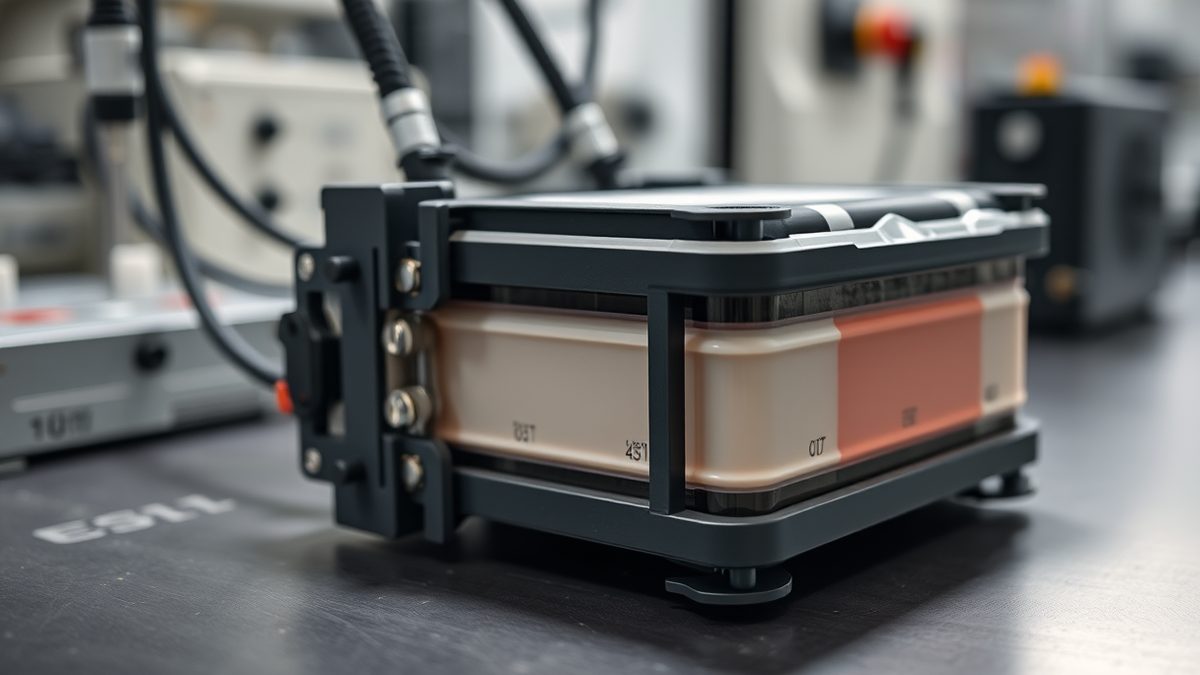
The company says the pack has been tested by VTT Technical Research Centre of Finland. The results will appear in a video series and on a site set up for critics, idonutbelieve.com. Solid-state and sodium chemistries could make electric cars and grid storage safer and cheaper. Buyers and investors still cannot check the loudest claims. The next checkpoints are Donut Lab's data and whether factory gains hold outside one test site.
Donut Lab promises independent test data
Donut Lab says the battery delivers 400 watt-hours per kilogram, charges in under 10 minutes, lasts 100,000 cycles and works from -30C to 100C. Conventional lithium-ion packs typically reach 200 to 300 Wh/kg and last around 1,500 to 3,000 cycles. At CES, where the startup first showed the battery, no hard evidence, live demonstrations, patent disclosures or academic research accompanied those numbers. "Some of the world's largest battery manufacturers have already publicly called Donut battery a scam, saying that the specifications cannot be true," CEO Marko Lehtimaki said. He spoke in a YouTube video released on Friday.
Lehtimaki framed publication as a way to separate assertion from verification. "We are making this series to put measurable evidence in public view so people can separate what's asserted from what's verified," he said. He added that louder doubt makes it harder to raise the capital needed to scale the technology.
Factory test cuts battery formation time
Cornell University researchers, working with New York battery company C4V, have developed a method that cuts battery formation time by up to 60%, potentially saving large factories as much as $100 million in production costs. Interesting Engineering reported the results on 29 October.
Formation, the first charge and discharge cycles that build protective layers inside a cell, is one of the costliest steps in lithium-ion production. It accounts for roughly one-third of production costs and about a quarter of a factory's floor space. The team combined operando Raman spectroscopy with electrochemical impedance spectroscopy to watch those layers form in real time. Key resistance measurements stabilised after just 1.5 cycles, an early signal of how the interfaces were developing. Slower charging produced more uniform, inorganic-rich layers. Discharge could be accelerated without harm. Two accelerated protocols ran at C4V's facility in Binghamton, New York, and matched the company's conventional process. Shalabh Gupta, a system engineering manager at C4V, estimated that halving formation time or better could cut overall factory electricity use by 10% to 15%.
"Evaluating formation processes is typically very trial and error," said Vibha Kalra. She is the study's principal investigator.
Solid-state batteries reach small-batch production
Xpeng vice president Gu Jie said on Wednesday, 28 October, that solid-state batteries for the company's Iron humanoid robot had begun rolling off the production line in small batches. The robot itself is still in pre-production. CnEVPost reported the remarks, made at a conference of the Society of Automotive Engineers of China.
Xpeng plans to mass-produce Iron by the end of 2026 and to deploy it in stores and other commercial settings from 2027. The battery is built around the robot's limited internal space, with a structure meant to stop thermal runaway from spreading. Gu said it passed impact and nail-penetration tests. It used the term "solid-state battery" without specifying whether the cells are the all-solid-state technology Xpeng announced in November 2025. It gave no energy density or production volume figures. Jipian Lab reported on 3 September that the production version of Iron would use a semi-solid-state design instead.
Sources
28- 01Donut Lab Remains Defiant About Its Solid-State Battery, Saying Proof Is Coming SoonEN
- 02Battery manufacturing breakthrough cuts formation time by 60%EN
- 03Solid-state batteries for Xpeng's Iron humanoid robot enter small-batch productionEN
- 04Waterloo researcher receives Canada's highest recognition for scientific excellence for work with batteriesEN
- 05iPhone 18 rumors suggest a bigger battery, higher price next yearEN
- 06What type of battery does the Slate Truck use?EN
- 07Rapid LLM development is outrunning the research meant to explain it, study findsEN
- 08Hanwha Q-Cells shifts focus to research and development in EuropeEN
- 09Nio adds 10 million battery swaps in 88 days, taking total past 130 millionEN
- 10Novel electrolyte advances sodium battery chemistryEN
- 11Swarm Of Electric Trucks Coming To US (Battery Swapping Included?)EN
- 12Quantum Interconnects Link Two 120-Qubit Processors (IBM Research)EN
- 13Hyperion Research: Nearly 20% Growth in HPC and AI-for-Science Server Market, Dell Takes Lead from HPEEN
- 14How Europe’s battery passport could have a big impact on US e-bikesEN
- 15Global EV battery market share in January-September 2026: CATL 39.1%, BYD 15.2%EN
- 16Batteries Beat Norway’s Hydrogen Bulk Carriers on Cost in Two Modeled RoutesEN
- 17The Share of Solar Generation with Co-located Battery Storage Is IncreasingEN
- 18 On this day in space! Oct. 30, 1964: NASA's weird Lunar Landing Research Vehicle takes 1st test flight to help Apollo astronauts land on the moon EN
- 19GAC's battery unit Inpow starts production at Thailand plant, its first overseas pack facilityEN
- 20Microsoft Research Focus – Edition #97EN
- 21Scaling European Battery Recycling via the Circular Economy ActEN
- 22PJM desperately needs grid batteries. Here’s a way it could get some.EN
- 23Li Auto launches 2026 i6 with unchanged starting price, upgraded in-house chip and batteryEN
- 24Researcher-in-the-Loop Evolutionary Discovery of Entanglement-Assisted Quantum Code FamiliesEN
- 25Can battery swapping and energy storage power CATL’s next phase of growth?EN
- 2675 Breakthroughs by America's National Laboratories - Department of Energy (.gov)EN
- 27What Women in Indonesia and Malaysia Want From Research on Climate and HealthEN
- 28Claude helped plan risky bird flu research. What did the AI add?EN
All figures and quotations in this text come from the sources listed below.
Content prepared by the editorial team with AI assistance.
Sofia Marchetti
Comments
0- No comments yet — be the first.