Opentrons raises $40 million Series E to push robots, not models, into the lab
Opentrons Labworks has raised $40 million in Series E funding led by healthcare investor Avego, with BroadOak Capital Partners participating. Pulse 2.0 and Robotics & Automation News reported the round on 30 October 2026.
 Rachel NwosuAI, models and technology
A $40 million round with no valuation attached
Healthcare investor Avego led the $40 million Series E round. BroadOak Capital Partners also participated.
Existing investors include SoftBank Vision Fund and Khosla Ventures, according to Pulse 2.0 and The AI Insider. Opentrons is based in New York City and was founded in 2014. That puts roughly a decade of lab automation sales behind this round. Opentrons did not disclose its valuation. It also did not disclose the ownership stakes investors acquired. Without those figures, the public cannot check whether Opentrons raised the $40 million above, at or below the price of the previous round. The silence leaves the price of the round unknown outside the company.
The bottleneck argument the round is built on
Opentrons argues that the physical lab, not the model, is now the constraint on experiments.
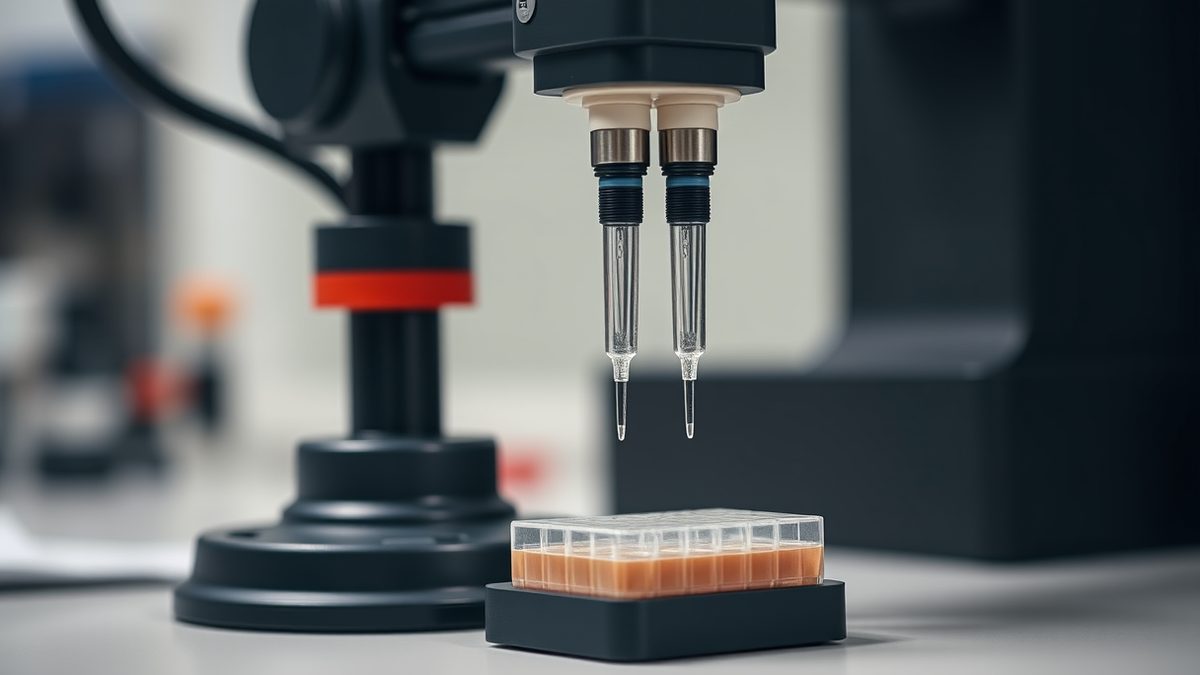
AI proposes experiments faster than labs can run them, the company says. The Opentrons Flex platform pairs laboratory robots with software and AI tools. Those tools are meant to design, run and refine experiments in a continuous loop. Each run through an Opentrons system produces structured, reproducible data that later AI cycles can use, according to the company. Opentrons says physical laboratory execution is an increasingly important bottleneck as models get faster at proposing experiments. "Millions of scientists spend much of their day on manual work a robot can do," CEO James Atwood said.
"Giving that time back to discovery is the biggest opportunity in science," CEO James Atwood said.
Where the money goes
Proceeds will fund AI-driven experimental execution and expanded automation capabilities. Opentrons calls its architecture open and API-driven.
The company also plans to enter new markets and geographies. It also plans to speed up protocol development and integrate its robots more deeply with third-party instruments and software. That framing matters for labs that already own its hardware. The promise is an upgrade path rather than a rip-and-replace. Opentrons says the money will also support additional automation across its robotics portfolio and deeper integration across laboratory systems. Protocol development is on the list, alongside the robots themselves. The company said the round will support expansion of its robotics, software and laboratory data infrastructure.
The installed base behind the pitch
Opentrons says it has deployed more than 11,000 robots in laboratories across more than 80 countries. Those are company figures. 90% of the 20 largest global pharmaceutical companies use its systems, according to Opentrons. The customer list also includes every top-20 U.S. research university and 14 of the 15 largest global biopharmaceutical companies. The announcement does not say how many of those installations are on paid service contracts. It also does not say how often the robots run. Its customers span pharmaceutical manufacturers, biotechnology developers, diagnostics laboratories and academic research institutions. Avego managing partner James Flexner said every AI-driven discovery still has to be tested in a real lab.
"Drug developers and AI companies alike are moving experimental work forward toward automated workflows that generate usable data," Flexner said.
What the announcement does not settle
Opentrons disclosed neither the valuation nor the investor ownership stakes. The funding announcement named no new customers. Opentrons did not give any revenue figures or a timeline for the new markets it plans to enter. It also did not quantify the claim at the centre of the funding round. Opentrons says its robots act as an execution layer that connects AI models to physical laboratory work. The funding announcement asserts that claim rather than measuring it. The announcement does not address whether the software upgrade path actually shortens experiments.
Sources
21- 01Opentrons Raises $40 Million Series E To Expand AI-Driven Laboratory Automation - Pulse 2.0EN
- 02Opentrons Raises $40 Million Series E Led by Avego to Expand AI-Driven Laboratory AutomationEN
- 03Opentrons raises $40 million to expand AI-powered lab automation - Robotics & Automation NewsEN
- 04Opentrons Announces $40M Series E Round to Standardize AI-Driven Science on Its RobotsEN
- 05Rapid LLM development is outrunning the research meant to explain it, study findsEN
- 06Hanwha Q-Cells shifts focus to research and development in EuropeEN
- 07Android-Smartphones sichern Fotos jetzt automatisch auf Windows-PCsEN
- 08CyberKord raises €2.7M to automate IT and cybersecurity operations with AIEN
- 09Quantum Interconnects Link Two 120-Qubit Processors (IBM Research)EN
- 10Open Science: The open-source AI workbench for scientific researchEN
- 11Accelsius Supports NSF Data Center Efficiency Research at VillanovaEN
- 12Hyperion Research: Nearly 20% Growth in HPC and AI-for-Science Server Market, Dell Takes Lead from HPEEN
- 13Chinese automakers reportedly head to Beijing for talks on EU hybrid export quotasEN
- 14Avoiding an uncontrolled reentry; boost Hubble and keep the science – IsaacmanEN
- 15 On this day in space! Oct. 30, 1964: NASA's weird Lunar Landing Research Vehicle takes 1st test flight to help Apollo astronauts land on the moon EN
- 16Microsoft Research Focus – Edition #97EN
- 17Researcher-in-the-Loop Evolutionary Discovery of Entanglement-Assisted Quantum Code FamiliesEN
- 18From 1D Benchmarks to Complex 3D Geometries: Can Agents Reliably Specify Problems for Automated PDE Simulation?EN
- 19What Women in Indonesia and Malaysia Want From Research on Climate and HealthEN
- 20Roller coaster safety is a matter of scienceEN
- 21Claude helped plan risky bird flu research. What did the AI add?EN
All figures and quotations in this text come from the sources listed below.
Content prepared by the editorial team with AI assistance.
Rachel Nwosu
Comments
0- No comments yet — be the first.