Perseverance finds organic molecules in ancient Bright Angel riverbed
NASA's Perseverance rover has found organic molecules in an ancient riverbed at Bright Angel in Jezero Crater, Purdue scientist Roger Wiens said. WIBC reported it as the first such detection in an ancient aqueous channel on Mars.
 Sofia MarchettiScience and health
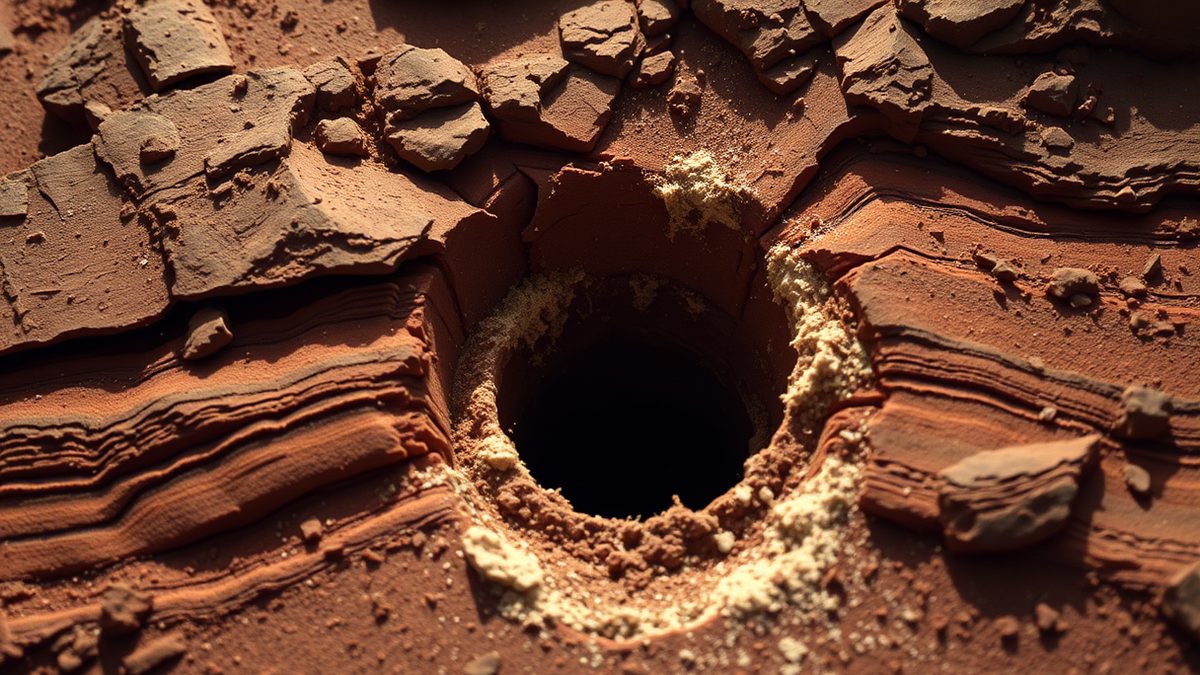
The Bright Angel sample
Perseverance drilled the rock at Bright Angel Trail and sealed a core in a tube that travels with the rover, according to WIBC. Near the site, Perseverance had already found clay, carbonate and sulfate minerals, materials that on Earth are known for preserving fossils, Yahoo News reported. Perseverance has studied Jezero Crater since 2021.
Wiens said the team found carbon bonded with hydrogen and oxygen. Organic molecules have been detected on Mars in small quantities before, but WIBC reported this is the first time they have been found in an ancient aqueous channel. The station said organic matter accounts for 99.99% of such carbon bonds on Earth.
The limits of the evidence
The WIBC report said the organics were found in the riverbed in tandem with reduction spots, dark circular features that on Earth are typically formed by rock-eating bacteria. Wiens said the location of the organics, given the riverbed and the reduction spots, is "extremely exciting." "The question is, what little organic material Mars has, is it from ancient life or is it simply out there from the cosmos?" Wiens said.
Organic molecules can be produced by living organisms, but they can also form through non-biological chemistry, including abiotic reactions tied to water or material delivered by meteorites, Yahoo News reported. Meteorites can carry organic compounds without any biological origin, according to WIBC. The source of the carbon remains unresolved.
A separate study in Science described organic-carbon signals from two Martian mudstones in Jezero Crater. Researchers said the result marks the strongest organic detection yet in the crater and the first confirmed detection of macromolecular carbon on an unaltered Martian rock surface, Yahoo News reported, adding that the finding is not proof that anything ever lived there.
Why the riverbed setting matters
Mars was once far wetter than it is today. Billions of years ago, rivers likely flowed into Jezero Crater and formed a lake, where mud and sediment built up before turning to stone, Yahoo News reported. If organic material was present at the time, those rocks may have preserved it.
The broader area includes the Cheyava Falls sample, which NASA has described as one of its strongest potential biosignatures. Yahoo News reported that researchers compared the Jezero readings with Curiosity's results in Gale Crater, roughly 2,300 miles away. The similarities hint that organic carbon, along with water that may have transported it, could once have been broadly distributed across Mars.
What happens next
Yahoo News reported that returning the samples to Earth would let far more powerful laboratory equipment determine exactly how the molecules formed. NASA and the European Space Agency had hoped to return the samples in the 2030s. The project was labeled financially unsustainable in the Trump administration's proposed 2026 budget and is now widely considered defunct, according to the same outlet.
China's Tianwen-3 mission could become the first to return Martian rocks, though it would target a region considered less promising than Jezero Crater. The Bright Angel core remains sealed on Mars.
Sources
26- 01NASA rover finds Mars' biggest cache of organic molecules, and the case for ancient life growsEN
- 02Organic remnants discovered on MarsEN
- 03Mars rover finds more organic material than ever before on red planetEN
- 04Life on Mars? Purdue Professor Discovers Organic MatterEN
- 05Mars’s Ancient Clay Holds the Same Organic Molecules That May Have Sparked Life on EarthEN
- 06Mars’s Ancient Clay Holds the Same Organic Molecules That May Have Sparked Life on EarthEN
- 07Trace Gas Orbiter discovers potential evidence of volcanic activity on Mars via atmospheric observationsEN
- 08 4-billion-year-old 'Rosetta Stone' found in Sahara Desert could unlock the secret history of water on Mars EN
- 09Marshall Heston 120 ausprobiert: Diese Soundbar hat bei mir zu Hause den Unterschied gemachtEN
- 10Scientists solve 30-year-old mystery and discover a hidden defense against inflammationEN
- 11 Mars isn't dead — recent volcanic activity reveals it's just sleeping EN
- 12Range Rover is axing its two cheapest SUVs, making way for a new entry-level EVEN
- 13AI helps Stanford scientists discover a “natural Ozempic” with a surprising advantageEN
- 14All 5 genetic “letters” of DNA and RNA discovered in a 4.5-billion-year-old asteroidEN
- 15Presentation: The Socio-Technical Staff+ Engineer: Architecture, Culture and Organisational ChangeEN
- 16Scientists discover new Alzheimer’s drug that repairs DNA damage and reduces brain inflammationEN
- 17Scientists discover that some “unhealthy” diets can boost cancer immunotherapy in miceEN
- 18NASA's Hubble and Webb discover ancient worlds that remember their pastEN
- 19Scientists shrink Archimedes’ screw to the size of a single moleculeEN
- 20Scientists discover the hidden “muscles” trees use to straighten themselvesEN
- 21Scientists discover metals that defy the deep freeze at -424°FEN
- 22Scientists discover a bacterial defense so strange they thought it was brokenEN
- 23A surprising vitamin A discovery is changing what scientists know about visionEN
- 24Scientists discover mysterious seahorse lookalikes that no one has ever seen aliveEN
- 25NASA discovers Jupiter’s invisible shield is more complex than Earth’sEN
- 26How AI Is Changing the Pace of Discovery for Millions Living With DementiaEN
All figures and quotations in this text come from the sources listed below.
Content prepared by the editorial team with AI assistance.
Sofia Marchetti
Comments
0- No comments yet — be the first.