Paleontologists name armoured stem amphibian that may be first known to live entirely in the sea
Paleontologists have named Gerrothorax maritimus, a 237-million-year-old armoured stem amphibian from Guizhou Province, China, that may be the first known stem amphibian to have lived entirely in the sea, in a Nature Ecology & Evolution paper published 26 October 2026.
 Sofia MarchettiScience and health
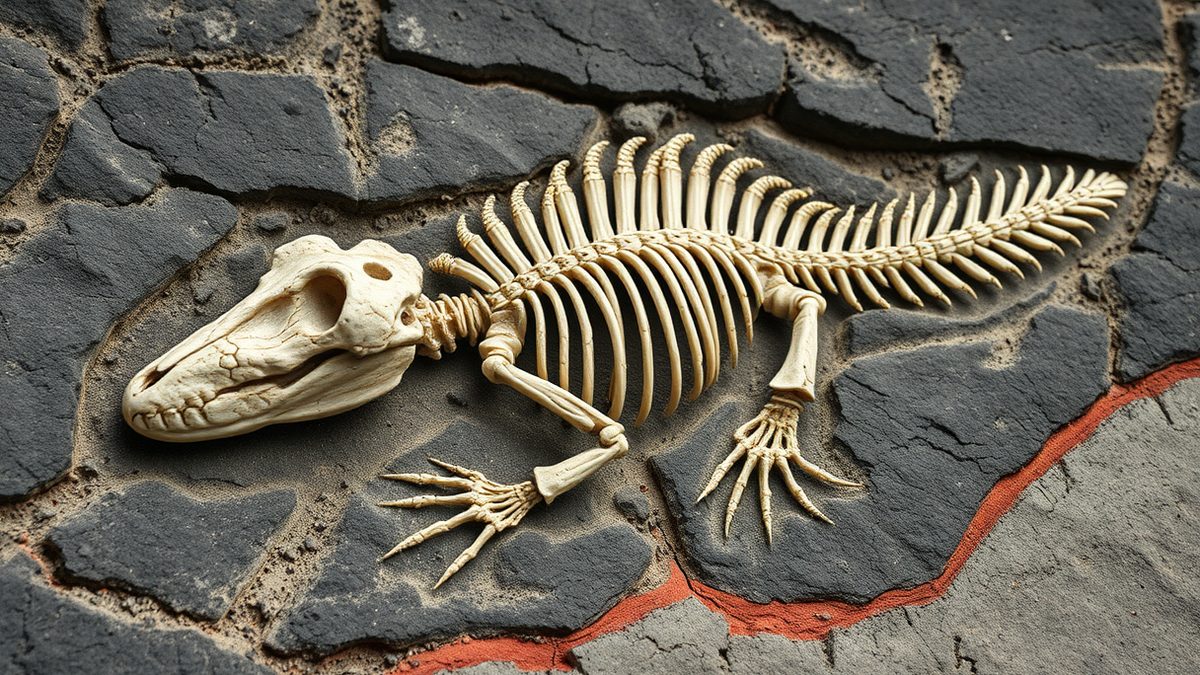
Two nearly complete skeletons from Guizhou Province, China, form the basis of the new species, Gerrothorax maritimus. The researchers describe a flattened body covered in heavy bony armour, a broad flat head, a wide mouth and well-developed gill arches. The better-preserved specimen measures at least 737 millimetres (73.7 centimetres) along its preserved midline, with a few tail bones missing.
The Guizhou skeletons
Local farmers collected the two skeletons in Guizhou Province in 2004, BBC Newsround reported. They came from rock about 237 million years old that forms part of the Guizhou Triassic Fossil Sites, ScienceAlert reported. Both fossils lay at least 30 kilometres from any possible island, about 18.6 miles.
Chemical evidence backed the marine setting. Strontium isotope ratios in the bones matched the signature of Late Triassic seawater rather than the surrounding rock, the team found. Limbs and fingers survived intact, which the researchers read as a sign that the animals died near where they lived; carcasses that float tend to dry out and shed limbs before sinking. The species name means "of the sea" in Latin. Its closest relative, G. pulcherrimus, is not known to have lived in the sea.
Why no living amphibian does this
Amphibian skin is permeable. It lets the animals breathe and take in water, and in seawater it works the other way, drawing water out of the body. High salinity adds a second problem on top of that water loss. More than 8,000 amphibian species exist today, but none lives entirely in the sea, and fewer than 2 percent show even some tolerance for salt. The crab-eating frog handles only a little before it needs fresh water.
Ryosuke Motani, a paleontologist at the University of California, Davis, explained that a frog in seawater loses body water through osmotic pressure and cannot drink to replace it, so it has to rest in fresh water to recover. Mammals, reptiles and birds all have marine species, which left amphibians as the holdouts. The team argues that G. maritimus got around the problem with armour that limited seawater passing through the skin, while its gills and gut managed salt.
Adults kept their gills and could breathe underwater, possibly without surfacing for air.
A bottom dweller with armour
Motani said the animal was chunky and probably about the same body mass as a giant salamander, though giant salamanders are elongated.
Researchers think it waited on the seafloor and sucked in prey, a style compared to the wobbegong, a modern carpet shark. Jiang Dayong of Peking University, the corresponding author, said it probably caught fish, worms and possibly cephalopods that passed nearby. It shared that seabed with ichthyosaurs, marine reptiles that reached about seven metres, and the armour may have helped against predators. In its freshwater relatives the bony plates probably evolved for defence and were repurposed for salt tolerance, the authors suggest.
Skin and organs were not preserved, so parts of its physiology and its reproduction remain unknown.
What the researchers say
Motani said the Guizhou site is an ecosystem the team has been reconstructing, mostly through marine reptiles and fish, which makes the amphibian an unusual member of the lineage.
The authors said the discovery broadens understanding of amphibian evolution, suggesting that ancient amphibians once used bony armour and other aquatic adaptations to sustain a fully marine lifestyle.
The conclusion rests on two specimens from one area.
Sources
22- 01This armored amphibian once lived and hunted on the seafloorEN
- 02Paleontologists Discover the First Known Amphibian That Lived Entirely at SeaEN
- 03Armored Amphibian from Triassic Period is First Known to Have Lived Entirely in the SeaEN
- 04Researchers discover first fully marine stem amphibian in Late Triassic fossilsEN
- 05Chinese-US team identifies 237-m-yr-old amphibian that lived entirely in the seaEN
- 06237-Million-Year-Old Armored Amphibian May Be The First to Live Entirely at SeaEN
- 07Armored Amphibian Fossils From China Suggest a Creature That Never Left the SeaEN
- 08Scientists solve the mystery of 237-million-year-old sea creatureEN
- 09Fossils of the first fully marine amphibian discoveredEN
- 10A new fossil from China may reveal the first amphibian known to have lived entirely at sea; the armoured, 2.4-foot creature lived about 237 million years ago, cEN
- 11China describes first fully marine stem amphibian — The Express TribuneEN
- 12EVgo opens its first Tesla Superchargers, with hundreds more plannedEN
- 13BYD’s electric hypercar hits 312 mph, first production car over 500 km/hEN
- 14Child dies of measles in Wisconsin’s first such death since 1990EN
- 15First: Volvo CE Electric equipment does the work, without disturbing the wildlifeEN
- 16Ancient ape fossil in Egypt could rewrite the story of human originsEN
- 17NIST Tests AI Tool to Map Building Interiors for First RespondersEN
- 18More of the Same Expensive Dependence on Fossil Fuels in TEP and APS 2026 Energy PlansEN
- 19237-Million-Year-Old Fossils Reveal an Amphibian That Shouldn’t Have ExistedEN
- 20No Intel, no Qualcomm: Huawei unveils desktop built entirely with China-made componentsEN
- 21Price hikes aren’t all that’s at stake in FirstEnergy Ohio’s rate caseEN
- 22Astranis Upgrades Falcon 9 Launch Contract to Dedicated Mission for Entire Block 4 Production Run of SatellitesEN
All figures and quotations in this text come from the sources listed below.
Content prepared by the editorial team with AI assistance.
Sofia Marchetti
Comments
0- No comments yet — be the first.